
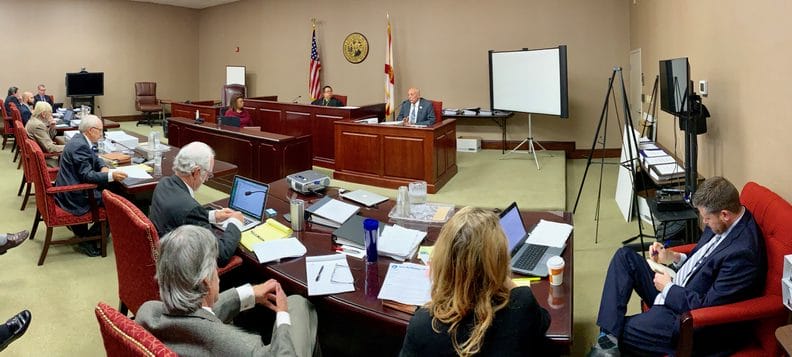
BMAPs hearing in Tallahassee. Photo from Florida Springs Council.
The Florida Springs Council has released the following news about a court challenge to the DEP BMAPs.
The BMAPs are just another make-work job to keep the DEP employees busy, pretending to restore our springs and rivers, and even the DEP admits they will not work.
They have no intention of restoring our springs and rivers as the unwritten force behind our governor and legislature is that industry must prevail at all costs.
Although some competent scientists work in our water protection agencies, they are on a short leash and not allowed to offend the money corporations.
Just last week, DEP representative Adam Blalock stood before a legislative committee in Tallahassee and promoted the BMAPs as the solution to Florida’s water woes, even though just minutes before Dr. Robert Knight of the Florida Springs Institute told the same committee that they were useless.
Indeed the DEP knows very well that they will not work, but they sent out Mr. Blalock to intentionally misinform the legislative committee.
What is the word to describe this? Several come to mind, none of which the guilty DEP would like to hear. Keep in mind that the Florida taxpayers pay the people who do this kind of misleading, disgusting work.
The DEP is an abuse of power.
Some respite we could call poetic justice has finally come out of this four-year battle. That the challenge was even necessary speaks to the woeful state of Florida’s water protectors.
Comments by OSFR historian Jim Tatum.
jim.tatum@oursantaferiver.org
– A river is like a life: once taken,
it cannot be brought back © Jim Tatum


THIS TIME AGAINST THE DEPARTMENT OF ENVIRONMENTAL PROTECTION
Today, springs advocates achieved the biggest legal victory in recent memory.
The 1st District Court of Appeals ruled that DEP’s water quality restoration plans for 13 Outstanding Florida Springs (Basin Management Action Plans, or “BMAPs”) do not meet the minimum requirements under Florida statutes.
The ruling forces DEP to draft new, effective BMAPs for Outstanding Florida Springs.
Florida Springs Council not only fights for Florida’s environment, but wins.
Our wins keep coming, but we are in need of financial support as we head into new battles. If you’re already a member, please consider a significant one-time donation to the Florida Springs Council. For those of you with Donor Advised Funds, we’ve made it easy! Or become a monthly recurring member, it allows you to divide your support into automated monthly donations.
Our team of lawyers and experts are ready to win more major victories for Florida’s springs and river. We will be in court again soon with our challenge of the Seven Springs/Nestle water use permit, putting your donations where they matter most.
| DONATE NOW |
BACKGROUND
In January of 2019, the Florida Springs Council challenged the ineffective springs BMAPs, arguing that the plans did not meet the minimum requirements under law.
We were joined by seven organizations – Rainbow River Conservation, Sierra Club, Save the Manatee Club, Our Santa Fe River, Ichetucknee Alliance, Silver Springs Alliance, and Friends of the Wekiva River – and three individuals, Jim Tatum, Tom Greenhaugh, and Paul Still.
For four years the Florida Department of Environmental Protection (DEP) took the side of polluters in court. DEP argued that the BMAPs did not need to actually achieve water quality goals, only have a “target” for doing so, and that they did not need to assign pollution reductions to categories of non-point sources.
After a seven day hearing in 2019, an Administrative Law Judge ruled on behalf of DEP, upholding the flawed BMAPs. But, thanks to our members, FSC had the resources to appeal the ruling to the 1st District Court of Appeals.
Today, the 1st DCA ruled on behalf of springs advocates, throwing out the non-compliant BMAPs and
ordering DEP to draft new BMAPs that follow the law.
DIVE DEEPER
Florida law requires that the Basin Management Action Plans for Outstanding Florida Springs include a detailed allocation of the allowable pollutant load for each point source or category of non-point sources.
While it sounds complicated, it’s really just common sense. The plan must identify how much each type of pollution source – agriculture, septic tanks, urban fertilizer – must reduce their pollution to achieve water quality goals.
DEP refused to include the allocations in the BMAPs, despite the clear requirement in state law to do so. The result was toothless BMAPs that did not require any pollution source to meet any reduction goal.
Today’s victory changes that. DEP will now have to redo the BMAPs and assign pollution reductions to each category of pollution. Then they will have to create plans that achieve the required reductions.
As the 1st DCA notes in their ruling, the Legislature found that “action is urgently needed” to protect and restore Florida’s springs. Thanks to the Florida Department of Environmental Protection’s refusal to follow the law in the first place, and their determination to side with polluters in court, we have lost years towards achieving healthy springs. DEP needs to make amends by urgently adopting new Outstanding Florida Springs BMAPs that meet the requirements of law and achieve water quality goals by 2038.
LOOKING AHEAD
While we celebrate this victory, let’s not forget that it never should have been necessary to fight in the first place. We should be able to trust our state agencies to follow the law. And we should be able to trust the Florida Department of Environmental Protection to protect the environment, not polluters.
Until that is Florida’s reality, the Florida Springs Council and our members will be there to hold them accountable. None of this would have been possible without your support.
Best,
Ryan Smart
FSC Director






Thanks for all the efforts of the Florida Springs Council and other organizations and individuals for fighting to protect our endangered rivers and springs. This victory is hopefully one of many yet to come. Your passionate work to save our rivers and springs is vitally important. It’s obvious that we can’t leave the stewardship of these of vital resources to the DEP, our governor of state legislature.