
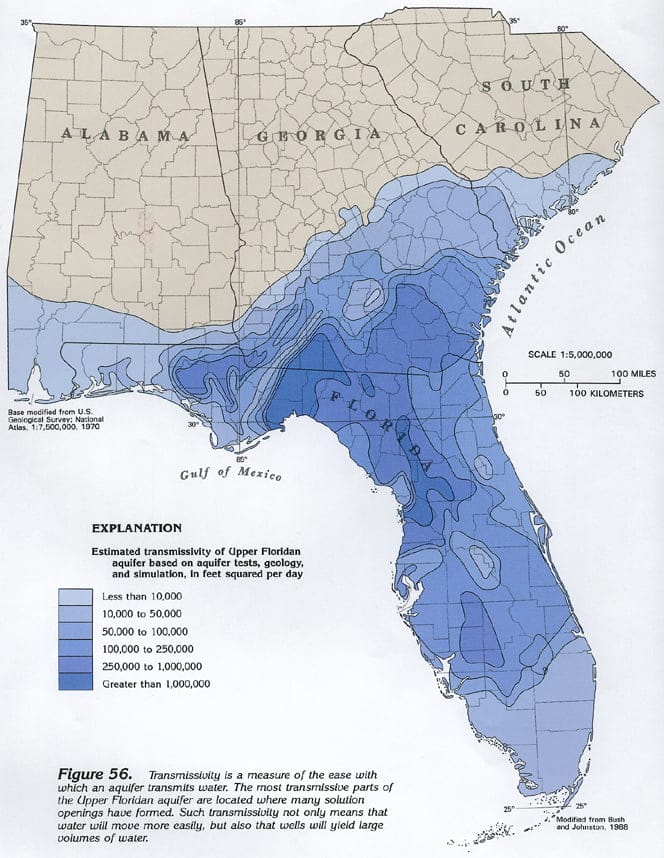
Much of North Florida’s underground geology is composed of limestone karst, with many divergent waterways and caves in which the Floridan aquifer moves, slowly in some places and fast in others. Gravity generally pulls it from north to south and it may be very near the surface in some places but far below in others.
Read the original article with photos here in the Gainesville Sun.
Comments by OSFR historian Jim Tatum.
jim.tatum@oursantaferiver.org
– A river is like a life: once taken,
it cannot be brought back © Jim Tatum

There is a scene in Wes Skiles’ brilliant film, “Water’s Journey,” where a team of divers is deep beneath the Floridan Aquifer charting unexplored water hundreds of feet below the earth’s surface. Above them, a scientist is able to follow their path through a suburban back yard, through a Sonny’s barbecue, until the divers surface in a muck-filled, oil-stained sinkhole.
Try this yourself. Walk out into your backyard, or to the gas pump or just about any place in Florida, and look down. It is likely a river runs beneath your feet.
The water in that river is also running through you. Your body is some 60% water. The same water that surfaced from the aquifer into the polluted sinkhole has also made its way into your well or city water system, out your spigot and into your body, which depends on clean water to filter its own toxins and waste.
Decades later, I visited the Ichetucknee with my poetry teacher and spiritual mentor, the Pulitzer Prize-winning poet Richard Eberhart. I was producing a documentary about him and wanted to include his poem “Ichetucknee” in the film. Eberhart observes, “Upon us the welling up of the source/Around us the gift of the river, the way we must go/Our bodies delight in the flow of original life.”
In fact, we started shooting my first film, “Seven Ways to Kill the Suwannee,” in 1980. Weeks before we arrived to film at the historic springhouse at White Springs, the spring had gone dry, a mere puddle where once 19th century tourists bathed in its mineral rich, invigorating waters.
So the next time you’re dining at your favorite barbecue, or strolling with your dog at the park, or sitting in your easy chair, see that river flowing beneath you and consider the term “water body.”
To borrow from Walt Whitman and Bob Dylan, you “contain multitudes.”
Author and filmmaker Steve Robitaille lives in Gainesville. His films can be viewed on YouTube and his novel, “Bartleby’s Revenge,” is available on Amazon. This column is part of The Sun’s Messages from the Springs Heartland series.


