
Of all the negatives from bottled water, and they are many, a new one has emerged which may be among the most serious of all; ingesting microplastics.
The following statement is from PNAS: The Proceedings of the National Academy of Sciences (PNAS), a peer reviewed journal of the National Academy of Sciences (NAS), is an authoritative source of high-impact, original research that broadly spans the biological, physical, and social sciences. The journal is global in scope and submission is open to all researchers worldwide.
We estimate that the exposure to the micro-nano plastics from regular bottled water was at the level of 105 particles per liter, which is two to three orders of magnitude more than the previously reported results merely focusing on large microplastics (SI Appendix, Table S4) (58, 59, 61, 69, 70).
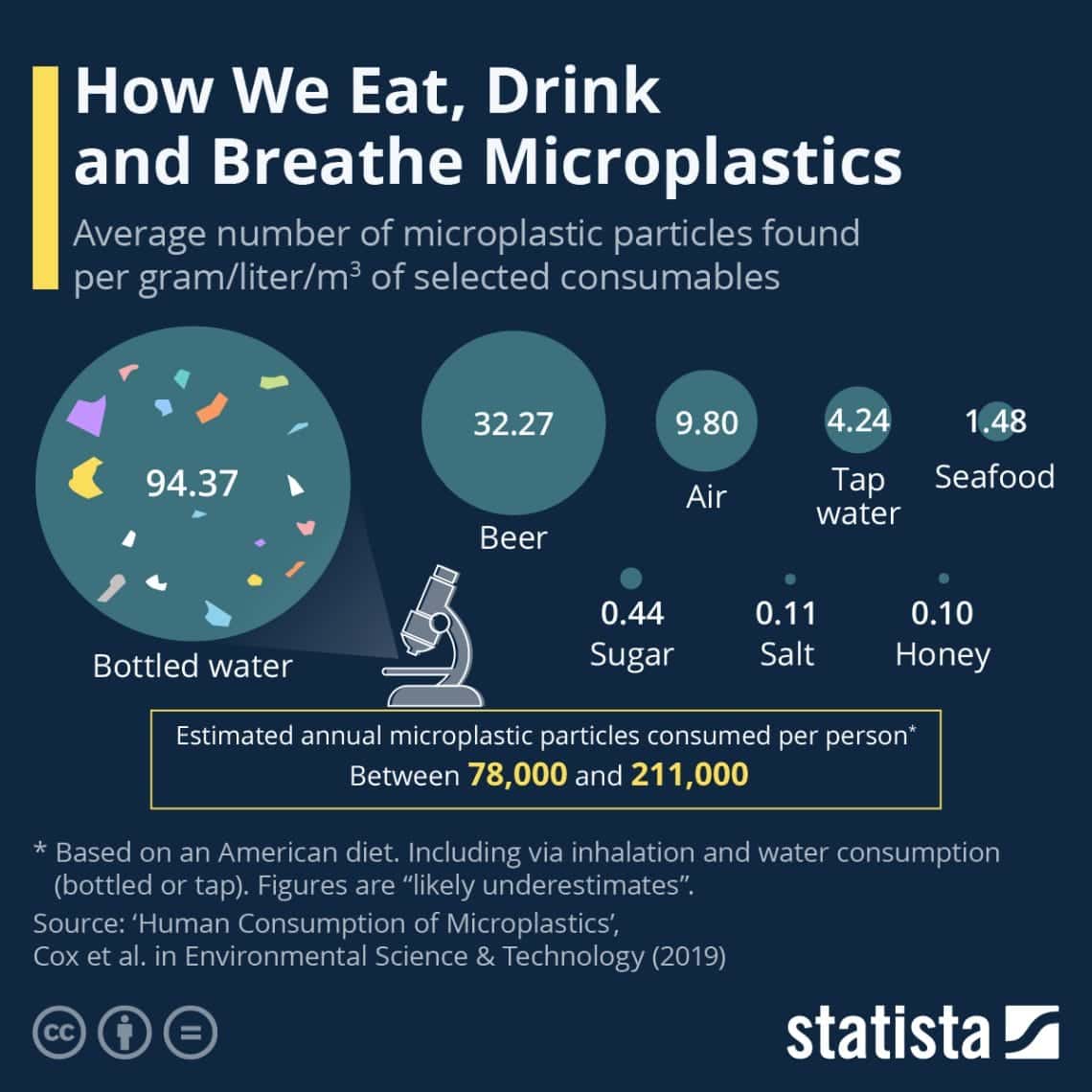
Note in the graph below the huge difference between bottled water and tap water, the former contains more than 23 times more plastic than the latter.
Read the original article here in the New York Times.
Comments by OSFR historian Jim Tatum.
jim.tatum@oursantaferiver.org
– A river is like a life: once taken,
it cannot be brought back © Jim Tatum
Microplastics Are Everywhere. Here’s How to Avoid Eating Them.
Microplastics and nanoplastics are everywhere.
Still, it’s probably a good idea to lower your exposure to microplastics even if you can’t avoid them completely. Although you can cut back your exposure in as many ways as there are sources of plastic, the experts I spoke with recommended focusing on exposures from water, food, and air.
I talked to three doctors and a research scientist for tips on how to reduce the amount of tiny plastics and their chemicals that you (or your kids) might ingest. Here’s what they recommend.
1. Cut back on bottled water
Bottled water is a significant source of microplastics. In fact, it’s the most concentrated source, according to a study from 2019.
2. Get an NSF-certified water filter
Switching to tap water from plastic bottled water will likely significantly reduce your routine exposure to plastics. But while the average plastic water bottle contains more microplastics and nanoplastics than tap, research shows that tap water may also be a source of microplastics.
Several of our water filter picks are specifically National Science Foundation/American National Standards Institute–certified to reduce microplastics, which means they’ve been rigorously tested in an accredited lab. They’re certified only to reduce since the filters cannot guarantee total elimination. Our picks include under-sink filters, such as the Aquasana AQ-5200, and the Brita Elite, a pitcher filter.
Our pick
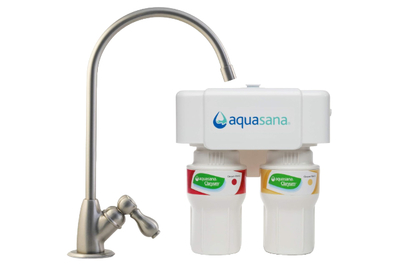
Certified for the most contaminants, widely available, affordable, and compact.
$100 + FS w/code AQWC50
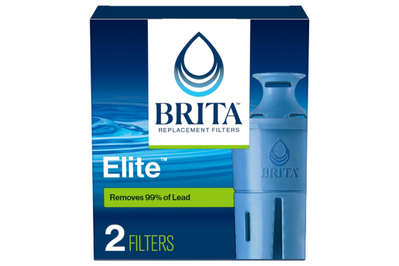
This 10-cup, user-friendly model is rated to last six months between replacements.
Yes, it’s ironic that most NSF/ANSI-certified water filters contain plastic. But any microplastic shedding from using the plastic filter is likely to be minimal, as long as you avoid running hot water through the filter and store your water in the fridge, since heat accelerates plastic degradation.
Research suggests that boiling tap water, cooling it, and then filtering it may be especially effective at reducing microplastics, although it’s less practical for most people than simply using a filter.
3. Don’t use plastic to store food
Plastic food storage and packaging is so common that it’s difficult to avoid entirely. But your safest bet is to avoid storing food or liquid in plastic when possible and to minimize exposing any plastic (even those that say they’re BPA-free or microwave-safe) to high heat. Sunlight, acids, and physical erosion can also degrade plastic.
4. Don’t reuse single-use plastics for food and drinks
It’s great to reuse single-use plastic—just not for food. Unless you’re using the plastic in the freezer, save it for something that isn’t food storage or reheating, said Dr. Gillian Goddard, an endocrinologist and author at ParentData, a science-based online resource for parents. That means don’t reuse plastic takeout containers, breastmilk bags, or drink bottles.
5. Don’t microwave in plastic
Avoid microwaving or heating food or water in plastic—even if it says it’s microwave-safe, said Tracey Woodruff, director of the Program on Reproductive Health and the Environment at University of California San Francisco. Instead, consider glass or ceramic. The Pyrex Simply Store 18-Piece Set is our pick for the best food storage containers, and they survived our drop tests, stack neatly, and come with user-friendly lids (although you may not want to microwave the plastic lids). Our runner-up, the leakproof Glasslock 18-Piece Container Set, is another great option.
Our pick
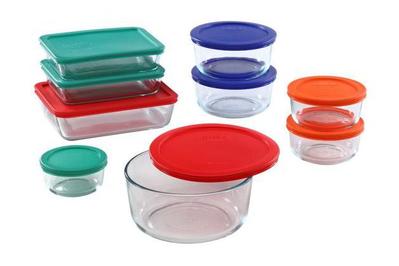
The Pyrex Simply Store containers stack neatly and are made from durable tempered glass. The colorful lids make it easier to match their shape to the corresponding container, though you may need to replace them over time.
Runner-up
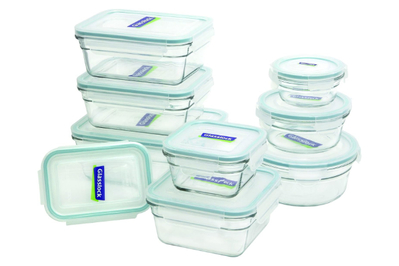
The Glasslock containers have locking lids that will prevent leaks. But these lids also put stress on the lips of the containers, so the glass may be prone to chipping over time.
6. Wash plastic by hand
Dishwasher temperatures run very hot and can degrade plastic—even dishwasher-safe plastic—and lead to microplastic shedding. Try to wash your plastic food containers by hand.
7. Use wood or bamboo cutting boards
Some research suggests that plastic cutting boards can be a significant source of microplastics in your diet, since repeated cutting on their surface can dislodge particles that adhere to food. Wood cutting boards also have some other advantages: They’re better for your knife blades and last longer than plastic when properly maintained.
Our pick
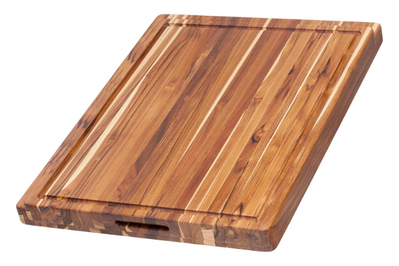
This beautiful teak board requires more careful cleaning than a plastic board, but it feels better under a knife and is easier to maintain than the other wood boards we tested.
Our cutting board pick, the Teakhaus Medium Professional Carving Board with Juice Canal 109, is made from sustainably harvested teak. If you still prefer plastic for certain uses, use it sparingly and replace it after heavy scarring.
8. Clean your air
The air we breathe is also a potential source of microplastics, in the form of dust. Reducing airborne dust in your home, then, may reduce your exposure to inhaled microplastics.
Our pick
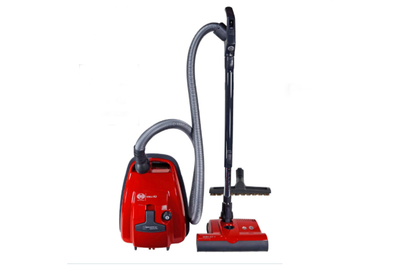
This bagged canister vacuum excels on both bare floors and carpets, and has many adjustment options and useful attachments. It should last for the long haul.
7-Year Standard Warranty
10-Year Extended Warranty
That means doing boring stuff, like vacuuming regularly with a bagged, sealed-system vacuum that has a HEPA or S-class filter and mopping and wiping down surfaces with a damp sponge or cloth (since dusting kicks those tiny particles back up into the air).
Our pick
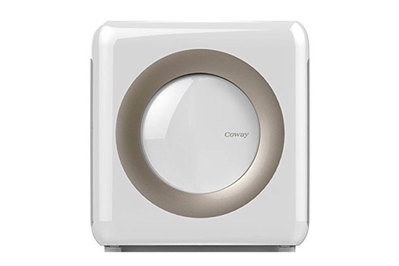
Perfect for bedrooms, playrooms, and living rooms, this air purifier is one of the highest-performing, most-durable, and most-economical models we’ve tested.
You should also take care of seasonal chores like cleaning fans and AC unit filters and changing HVAC filters, and consider getting an air purifier if you live near a busy road….
How worried should you be about microplastics?
Scientists are still studying the exact connections between these teeny tiny pieces of plastic and human health. But it’s clear that exposure to plastic—whether it’s those tiny particles, the chemicals they leach, or a combination—is being linked to a variety of worrying health issues.
Some of those connections still require more research, such as ties to colon cancer, respiratory disease, metabolic function, and disruption to endocrine systems, while others—like a recent study that found those with levels of plastics in their arteries were at a higher risk for heart attacks, strokes, and death—seem a little more clear.
It’s important to remember that these links point to concerns about the impact of microplastics on public health, but they are not specific, predictable outcomes. “What I’m thinking about is population risk, not a risk to a specific individual,” said Goddard.
The tricky thing is that microplastics and nanoplastics are impossible to avoid, no matter how diligent you are: They’re in the air we breathe, our drinking water, and our food. But scientists aren’t sure what levels of microplastics and nanoplastics we’re each taking in from those sources.
The oft-cited estimate that the average person eats a credit card’s worth of plastic every week has been called into question. But our bodies are certainly taking in plastic, and that’s more than nature intended.
Given the growing body of evidence, it’s possible that we’ll start to see more public health measures that address microplastic pollution. Until then, taking care of your overall health is the first line of defense, followed by taking reasonable steps to reduce microplastic exposure.
This article was edited by Christine Cyr Clisset and Ben Frumin.
Sources
-
Tracey Woodruff, director of the Program on Reproductive Health and the Environment at UCSF, phone interview, April 25, 2024
-
Gillian Goddard, MD, endocrinologist and adjunct assistant professor at NYU Langone Hospital and author of “Hot Flash” newsletter from ParentData, phone interview, April 26, 2024
-
Carlos Lerner, MD, pediatrician at the Children’s Health Center at UCLA and professor and Jack H. Skirball endowed chair in Pediatrics at UCLA, email interview, April 26, 2024
-
Hayley Goldbach, MD, board-certified physician and dermatologic surgeon at Brown University, email interview, April 29, 2024
Meet your guide

Katie Okamoto





this is confirmation of how microplaslic gets into our bodies . Why aren’t we wrapping our food in paper ?