
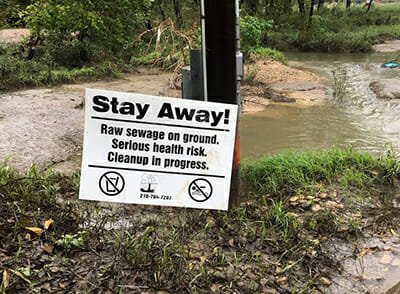
 It was already apparent, especially in areas such as Pinellas County and Valdosta Georgia, that our sewage systems were inadequate, but Debbie made it glaringly more so.
The important part of this issue is that Debbie is a harbinger of higher intensity weather phenomena brought on by human-caused climate change, so we can expect things to get worse instead of better.
We cannot blame the weather on all our sewage woes because human incompetency has been a large and unnecessary factor in many of our sewage spills.
Read the complete article here in the Tampa Bay Times.
Comments by OSFR historian Jim Tatum.
jim.tatum@oursantaferiver.org
– A river is like a life: once taken,
it cannot be brought back © Jim Tatum
Debby overwhelmed Tampa Bay sewers, spilling millions of gallons of pollution
Waterways including the Hillsborough River, Boca Ciega Bay and the Manatee River saw an influx of dirty water during the storm.
The deluge from Tropical Storm Debby this week swamped Tampa Bay’s sewage systems, causing millions of gallons of raw and partially treated wastewater mixed with rain to overflow into streets, canals and natural waterways.
Sewage bubbled out of so many manholes in Clearwater that city workers ran out of vacuum trucks, forcing them to use sandbags to hold off the polluted water until they could suck it up, according to reports the city filed with the state.
“We had three or five trucks running 24 hours just trying to do as much as we possibly could,” said Rich Gardner, Clearwater’s director of public utilities, who added that the trucks got “a fraction” of the total pollution.
Together, local governments and housing complexes in Pinellas, Hillsborough, Manatee and Pasco counties reported more than 6.3 million gallons of spilled sewage over the three days when Debby lashed the region, according to a Tampa Bay Times analysis of reports made to state environment regulators and posted on city websites. Lags in reporting mean this is almost surely a significant undercount.

In the single largest incident recorded so far, about 3.5 million gallons of raw and partially treated wastewater spilled out of a treatment plant and into the Manatee River in Bradenton starting Sunday, city pollution documents show.
The majority of the sewage spilled into regional waterways, spoiling creeks, rivers, lakes, bays and bayous. Thousands of gallons entered the Hillsborough River, Clearwater Harbor and, when a Tampa pumping station failed, into drains that lead to Old Tampa Bay.
Local officials said stormwater and sewage systems weren’t built to handle the sudden influx of water that Debby wrought. Parts of Hillsborough and Pinellas counties saw 10 to 14 inches of rain, according to rainfall data.
“When you have a storm like this one … (problems are) not limited to one municipality’s sewage system. It’s wastewater systems all across the region — because the rain was coming and there was nowhere for it to go,” said Bill Logan, a spokesperson for Manatee County. “It was an abnormal event.”
But environmentalists say it’s indefensible for a state accustomed to extreme weather to allow these spills to continue. Climate change is expected to increase the frequency of storms bringing heavy rainfall. Just in the last two years, parts of Florida have experienced two “100-year” rainfall events with Debby and Hurricane Ian.
“These tropical events are not a surprise. It is no longer an excuse to be OK with not prioritizing investments that get our wastewater infrastructure up to speed with the amount of folks that are here,” said Justin Tramble, executive director of the clean-water advocacy nonprofit Tampa Bay Waterkeeper.
“Crap is going to end up in our water — over and over again — until we as a community say we’ve had enough.”
Aging infrastructure a “massive problem…”
As Debby churnedoffshore of Tampa Bay on Sunday, Rep. Lindsay Cross, a St. Petersburg Democrat and environmental scientist, took to social media to issue a warning.
“Rain is here and will be for a while,” Cross wrote. “Please avoid doing laundry, running dishwashers or taking long showers. Our stormwater systems will be working overtime and excess water usage can add extra stress.”
Parts of Cross’ district loggedmore than a foot of rain over a three-day period, weather data shows. When the storm finally cleared earlier this week, the fallout of at least one overstressed water system in Cross’ district became clear: At least 185,000 gallons of raw sewage spilled from St. Petersburg’s Northeast Water Reclamation plant as crews scrambled to suction waste from manholes to stop them from overflowing into roads.
All told, about 81% of that sewage dumped into a canal that siphons into Smacks Bayou, the waterway surrounding the Snell Isle neighborhood. It was enough to fill more than 3,500 bathtubs, according to a pollution notice filed to state environmental regulators.
Cross saidaging stormwater infrastructure is a “massive problem” across Florida. Earlier this year, she fileda bill that would have identified the wastewater treatment plants in most need of upgrades, and the measure would have created a priority list for funding. The bill didn’t get a hearing.
St. Petersburg is no stranger to large-scale sewage spills. The city dumped at least 200 million gallons of waste from 2015-2016 in a sewage crisis that prompted intervention from state environmental regulators and slapped the city with a more than $300 million bill to improve the embattled waste system.
The amount of waste entering waterways because of Tropical Storm Debby is likely to fall well below the volume dumped during the peak of the crisis. As of Thursday, more than 400,000 gallons had spilled, according to the analysis, some of it into a nearby creek and lake.
Infrastructure repairs made since 2016 prevented more than 8million gallons of potential spills in the recent storm, according to a St. Petersburg city document.
In his first year as governor, Ron DeSantis proposed increasing the fines levied against city and county governments that spew sewage into waterways. He signed sucha bill into law four years ago.
But it is unclear if the state will fine Tampa Bay-area governments for these Debby-related incidents. The Florida Department of Environmental Protection said in a statement they are evaluating each spill to determine if violations occurred.

Dave Tomasko, executive director of the Sarasota Bay Estuary Program, a partnership including researchers and the state and federal environmental protection agencies, said the most beneficial step local governments could take would be to line outdated sewage pipes. That way, less rainwater seeps inside and gushes into treatment plants, overwhelming them.
State lawmakers approved $2.2 million to help Bradenton line its pipes for this reason. DeSantis vetoed the project in the budget.
The governor’s office did not respond to emails asking about the veto in light of the latest Bradenton spill.
Health and ecological impacts
Florida’s Department of Health has not tested the water quality at Tampa Bay-area beaches so far this month,according to data as of Thursday afternoon.
Margaret Mars Brisbin, an assistant professor of biological oceanography at the University of South Florida’s College of Marine Science, said she typically waits a few days after a major storm before she returns to the dog park beach at Fort De Soto with Ruby, her mini Australian shepherd.
The public should stay out of the water for at least a few days, Brisbin said.
Most people associate wastewater spills with common bacteria like E. coli or fecal coliform, she said, but there are other, lesser-known bacteria that enter the water after a storm, too. Brisbin pointed to diarrhea-causing campylobacter and a group of vibrio bacteria that can hurt human health.
It’s not just bacteria, either. The nutrient pollution that dumps into Tampa Bay waters could act as food for preexisting harmful algal species, like the one that causes red tide. It’s something scientists will be watching closely.
Already, the pollution has lowered oxygen levels enough in parts of Sarasota Bay that the estuary program expects small fish, clams and starfish to die.
The group is evaluating past wastewater plantsthat saw repeated sewage spills during storms to better inform the public about repeat offenders.
“We shouldn’t be OK with millions of gallons of treated and untreated wastewater going into the bay,” Tramble said. “At some point, enough is enough.”
/s3.amazonaws.com/arc-authors/tbt/72f25a5e-bd91-476e-9439-4bed39ab7d39.png "Emily L. Mahoney - Energy Reporter")
/s3.amazonaws.com/arc-authors/tbt/bfca9102-6591-4891-9560-58f0928e710c.png "Max Chesnes - Environment and Climate Reporter")


