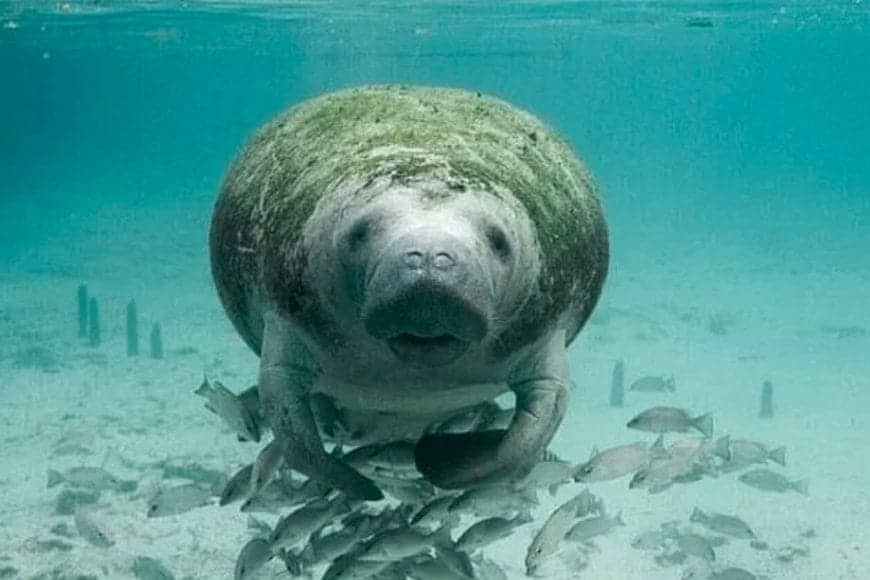
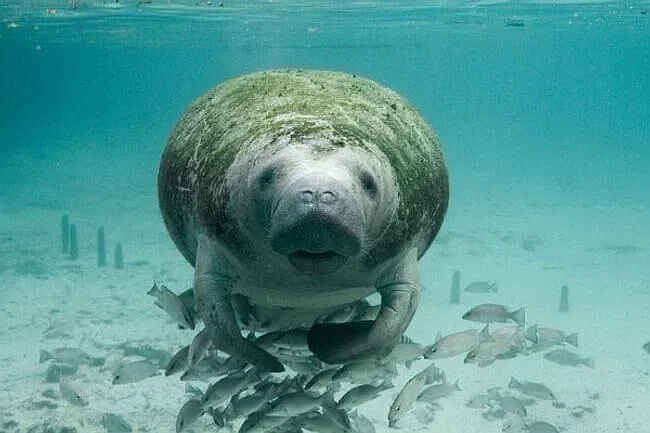
This is more about a fight over water than a fight over manatees. The State of Florida has allowed its waterways to become so polluted that the grasses on which manatees feed cannot grow. The result is that the manatees starve to death.
So now we see that the Florida Department of Environmental Protection and not protecting the manatees, they are fighting against them.
Read the original article here in the Palm Beach Observer.
Comments by OSFR historian Jim Tatum.
jim.tatum@oursantaferiver.org
– A river is like a life: once taken,
it cannot be brought back © Jim Tatum
Florida Department of Environmental Protection fights to overturn manatee protection order
The department is disputing a ruling that it violated the federal Endangered Species Act and an order that included a moratorium on installing septic systems around the northern Indian River Lagoon.
- By
- | 3:00 p.m. July 30, 2025
The department filed a 56-page brief and an accompanying motion to “expedite” the case at the 11th U.S. Circuit Court of Appeals. It is fighting a ruling by U.S. District Judge Carlos Mendoza that the department violated the federal Endangered Species Act and an order that included a moratorium on constructing and installing septic systems around the northern Indian River Lagoon, which is primarily in Brevard County.
The brief disputes that the department, which in recent years gained permitting authority over septic systems, has violated the Endangered Species Act. Also, the brief contends the Florida Fish and Wildlife Conservation Commission — not the Department of Environmental Protection — is constitutionally responsible for wildlife-related issues.
“This case is of exceptional importance because the district court’s injunction compels the wrong agency to create new government programs and commandeers that same agency to enforce federal law,” the brief said.
The environmental group Bear Warriors United in 2022 filed the lawsuit against the department, after Florida had a record 1,100 manatee deaths in 2021, with the largest number, 358, in Brevard County. The lawsuit argued, in part, that sewage discharges into the lagoon led to the demise of seagrass, a key food source for manatees, and resulted in starvation deaths and other harm to the animals.
Mendoza in April ruled the department violated the Endangered Species Act and followed in May with the order that included a moratorium on new septic tanks in the area and other measures, such as requiring establishment of biomedical-assessment and supplemental-feeding programs for manatees in the area. Septic tanks discharge nitrogen that can cause harmful algae blooms in waterways.
Also, Mendoza directed the state to seek what is known as an “incidental take” permit from the U.S. Fish and Wildlife Service. That process would include the state developing a conservation plan, which could provide “permanent protection and management of habitat for the species,” according to information about such permits on the federal agency’s website.
The Department of Environmental Protection appealed to the Atlanta-based appellate court and unsuccessfully sought a stay that would have at least temporarily put Mendoza’s order on hold. It followed Monday, July 28, with the 56-page brief….
“Plaintiff’s theory of causation turns on a lengthy, convoluted and speculative chain of events in which DEP (the Department of Environmental Protection) issues permits for septic tanks, the tanks are installed and used by third parties, those septic tanks release excessive pollutants into the lagoon, the pollutants combine with preexisting legacy pollutants to harm manatees’ food sources, the manatees are injured or killed from emaciation, and plaintiff’s members then see the injured manatees and face injury to their recreational or business interests,” the department’s attorneys wrote. “This chain of causation far exceeds that of other ESA (Endangered Species Act) cases in which plaintiffs were found to have standing.”
Also, the brief contended that factors other than septic-tank discharges contributed to pollution in the waterway.
“According to the allegations in the complaint (the lawsuit), significant amounts of nitrogen-containing untreated sewage have also been released within the past eight years as a result of Hurricanes Ian, Irma and others and from damaged sewer lines,” the brief said. “In each case, DEP took appropriate enforcement action against the municipalities responsible for those releases.”
But in ruling this spring, Mendoza said that under the agency’s regulations, it would take at least a decade for conditions in the northern Indian River Lagoon to start to recover.
“This is due to the previously and currently permitted discharge of legacy pollutants via wastewater into the north IRL (Indian River Lagoon),” Mendoza wrote. “These legacy pollutants caused the death of seagrasses — the manatee’s natural forage — and the proliferation of harmful macroalgae. Legacy pollutants, as their name suggests, persist in the environment and cause harmful effects long after they have entered the system.”
Mendoza added, “What all this means is that FDEP would have to reduce nutrients entering the IRL to a low enough level and for a long enough time for nutrients to cycle out of the system to allow seagrasses to return at significant levels. Conversely, if FDEP does not reduce nutrient levels, there will continue (to) be harmful algal blooms and, in turn, no seagrass recovery and more manatee takings.”
After the 1,100 manatee deaths in 2021, the state had 800 manatee deaths in 2022, before the number dropped to 555 in 2023 and 565 in 2024, according to Florida Fish and Wildlife Conservation Commission data. As of July 18, 477 deaths had been reported this year, with the largest number, 95, in Brevard County.
Manatees are classified by the federal government as a threatened species.