Two articles I came across recently show once again how our state dissimulates to hoodwink the public into thinking they are on top of our [nonexistant] water protection.
One is this article at the South Florida Water Management District (SFWMD) saying how science plays a part in their activities, and another by the Water First North group of the joint effort of the Suwannee River Water Management District (SRWMD) and the St. Johns River Water Management District (SJRWMD) to replenish wetlands with treated wastewater. This project is estimated to cost one billion dollars and take 13 years to complete. These articles are reproduced below for your perusal.
First off, I have no personal experience about the SFWMD’s use of science, but I suspect they do not always use “best” science when it is not convenient for them. State law requires that best science be used when reaching decisions affecting water. But I do have experience with other water management districts and state agencies when I have witnessed deliberate disregard of published data of which they were aware, when it was contrary to what they wanted the result to be.
This is inexcusable cheating to deceive the public.
The second article is about Water First North, where the heading gives quotes by some they call “environmentalists” which most are not. Environmentalists are not leaders of the water management districts, DEP and Jacksonville Electric Authority: these are the ones who are or who protect the users and abusers of water sources, the opposite of environmentalists.
No, environmentalists are people like Bob Knight, Bob Palmer, John Quarterman, Merrillee Malwitz-Jipson, Ryan Smart, Lisa Rinaman, Marian Ryan, Debra Johnson, Linda Young and many, many others who speak up but who are ignored by the water authorities.
Comments by OSFR historian Jim Tatum.
jim.tatum@oursantaferiver.org
– A river is like a life: once taken,
it cannot be brought back © Jim Tatum
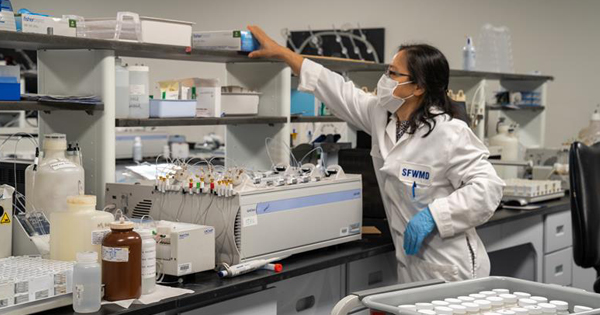
The South Florida Water Management District (District) uses sound science, accurate data and ongoing research to help guide important water management decisions.
DID YOU KNOW: The District’s actions are based on the expertise of scientists, researchers and modelers using the best available techniques and laboratory analyses.
EFFECTIVE WATER MANAGEMENT: Environmental information is essential to effective water resource management and restoration. Data combined with historical information about weather, rainfall and changes in vegetation or land-use help water managers make resource decisions that are based on sound science.
The District’s environmental monitoring program supports restoration projects throughout its 16-county region, including the Everglades, Kissimmee River, Lake Okeechobee, Big Cypress Basin, water conservation areas and stormwater treatment areas.
ENVIRONMENTAL DATA: As part of routine scientific efforts, the District monitors numerous environmental indicators, such as surface water, ground water, rainfall, fish, birds, invertebrates and sediments.
The District also closely monitors weather conditions throughout the year using an extensive rainfall monitoring network. When rain is scarce, water managers keep levels stable in canals, wetlands and lakes to protect groundwater supplies. In anticipation of heavy rainfall, they open gates and lower water levels in canals.
COMPREHENSIVE MODELING: Computer models are also important and powerful tools used by scientists to monitor, evaluate, study, and protect South Florida’s water resources and ecosystems. Rooted in mathematics, physics and hydrology, these comprehensive models allow scientists to simulate complex systems and test various conditions and scenarios to optimize operations throughout the District’s 16-county region.
Hydrologic models are used for evaluation, planning and simulating water control operations under different climatic and hydrologic conditions. Water quality and ecological models are also used to evaluate other processes vital to the health of our system.
ONGOING SCIENTIFIC RESEARCH: The District and collaborating agencies conduct ongoing scientific research projects to obtain a better understanding of the influence of regional hydrology and other factors on Everglades plant, landscape, wildlife and ecology systems.
DATA-DRIVEN DECISIONS: Accurate and reliable data and research is mandatory for operations, planning and implementing water quality improvements and environmental restoration efforts.
We encourage you to visit SFWMD.gov/Science to learn more about the District’s ongoing research, data and more.


