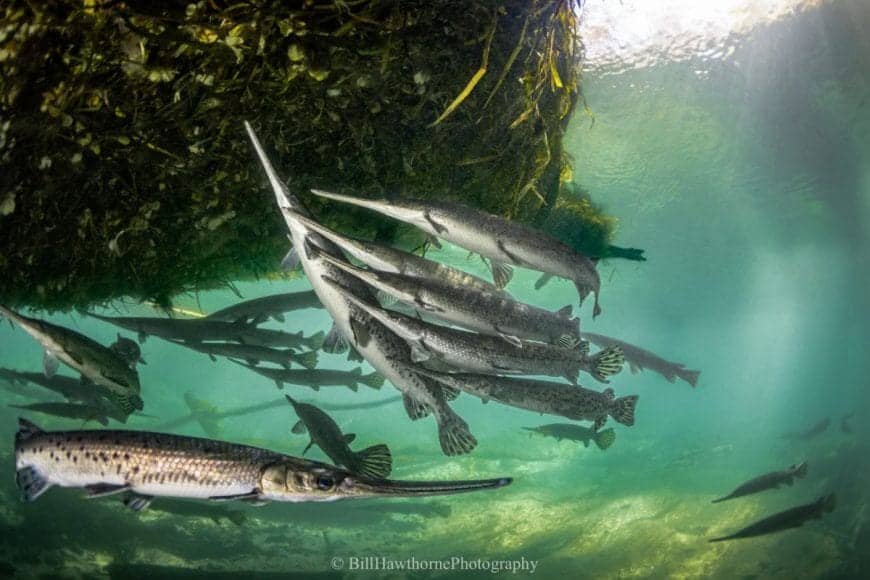
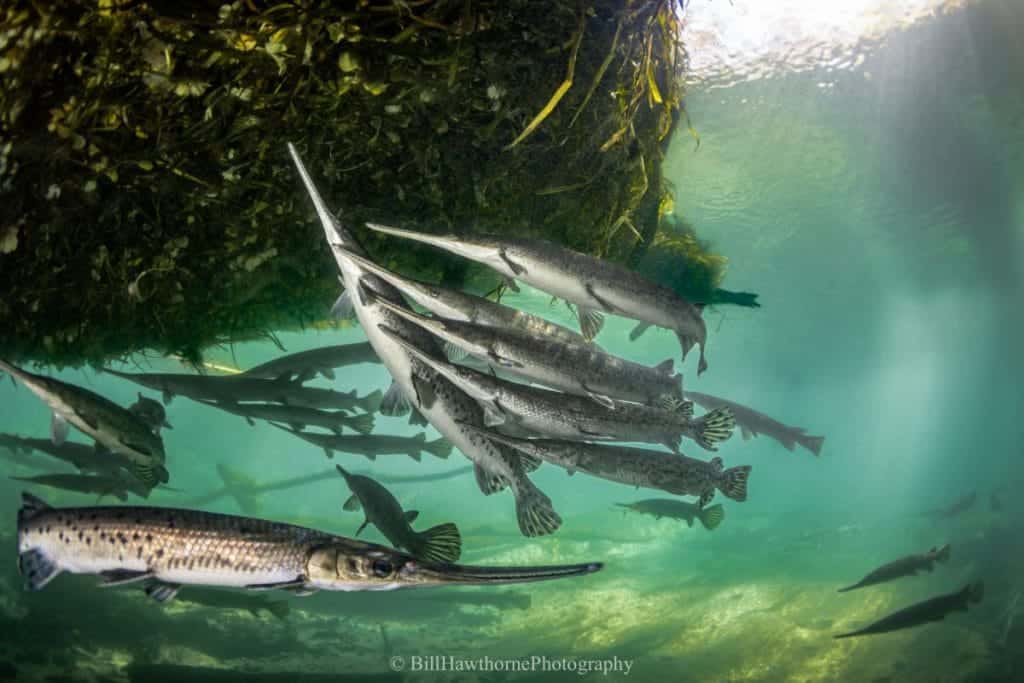
Between December and March, during the full on new moons, the Longnose Gar migrate up into our rivers to mate . Preferring the clear waters of the Ichetucknee, the gar gather to spawn within the vegetation mats composed mainly of water lettuce and detached Vallisneria eelgrass fronds, snagged by fallen trees.
This year’s spawning season followed debris removal in the Ichetucknee that removed the snags that anchor the floating vegetation mats that the gar rely on for spawning.
Understanding gar reproduction, we are able to select better timing of snag and lettuce removal to avoid interfering with the biological needs of wildlife.
Below you will find links to video footage of both 2024 and 2025 taken by IBSS, volunteers assisting Dr. Kenneth Sulak with his research of the Longnose Gar.


Dr. Kenneth Sulak, principal investigator of the Longnose Gar writes “One thing that the video documents is that Gar are adaptable, having moved upriver to spawn in response to removal of lettuce gathering snags downstream. This is something new to me since I have been gar-watching starting about 2010, more seriously from 2014 onward. Seems they do what they have to do to keep things going – even if that involves abandoning old favorite spawning sites down from Mill Creek. Also, serves to reinforce the close association with overhead floating vegetation. Old literature suggests that gar spawn on the river bottom substrate or on shoreline benthic vegetation – and that may be true in other systems. But, that does not seem to be the case in the Iche, or perhaps more generally for gar in Florida rivers and runs. Over time such habitat affinities can become genetically fixed for a regional population – happens in various fish species – genetic adaptation to the local habitat, water lettuce rafts in this case.”

OSFR President Joanne Tremblay
joanne.tremblay@oursantaferiver.org
“Giving Our River A Voice”