
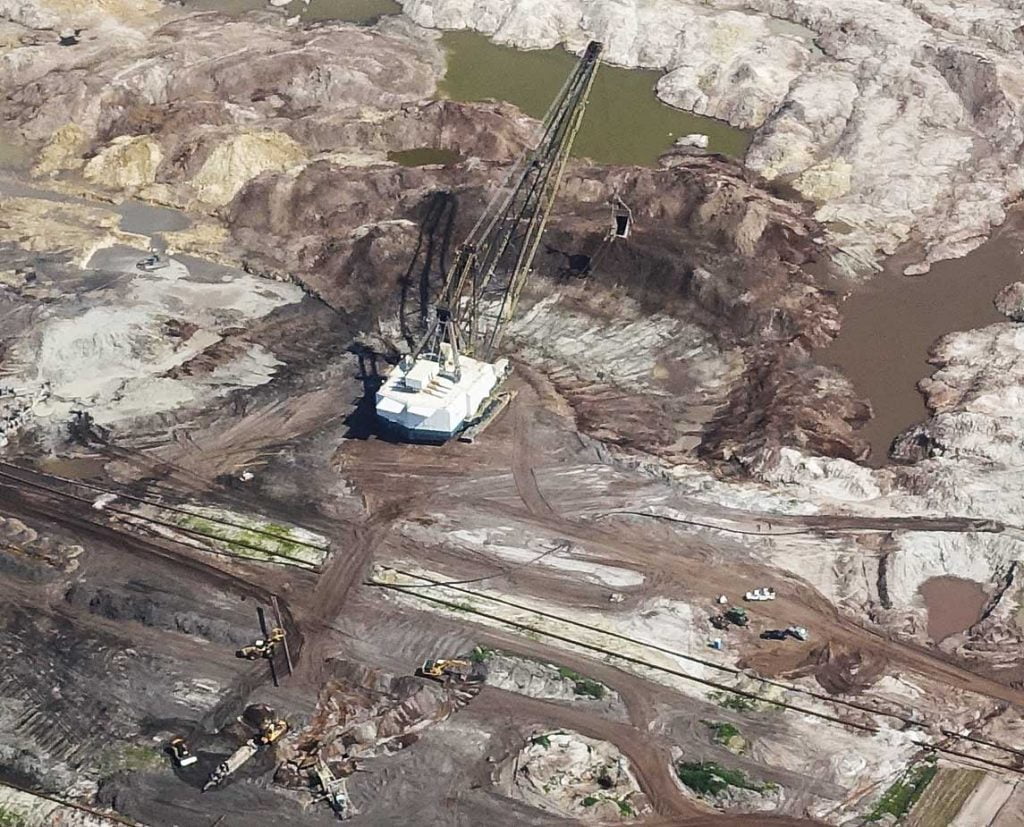
Mosaic territory is far from the Santa Fe River basin, but OSFR has been heavily involved in opposing phosphate mining due to its destruction of the environment and the close-to-home threat of HPSII.
Mosaic is responsible for poisoning the Alafia River and the Gulf of Mexico. It has been unable to prevent huge sinkholes reaching into the aquifer and spills of its holding ponds and gystacks.
Since it is legal to bribe legislators in Florida thanks to our corrupt Supreme Court and Citizens United, huge polluters such as the sugar and phosphate industries take advantage of this abominable situation.
Thanks to OSFR co-founder Merrillee Malwitz Jipson for this link.
Read the complete article here in Seeking Rents.
Comments by OSFR historian Jim Tatum.
jim.tatum@oursantaferiver.org
– A river is like a life: once taken,
it cannot be brought back © Jim Tatum
Florida lawmakers may help a mining giant fend off lawsuits
New legislation to stifle lawsuits targeting phosphate-mining companies is part of a broader effort by Florida Republicans to support the Mosaic Co., a Fortune 500 fertilizer giant.

This is Seeking Rents, a newsletter and podcast devoted to producing original journalism — and lifting up the work of others — about Florida politics, with an emphasis on the ways that big businesses and other special interests influence public policy in the state. Seeking Rents is produced by veteran investigative journalist Jason Garcia, and it is free to all. But please consider a voluntary paid subscription, if you can afford one, to help support our work. And check out our video channel, too.
For nearly five years, the Fortune 500 fertilizer giant Mosaic Co. has been trying to fend off a lawsuit brought by a pair of mobile homeowners in Florida who say they have been exposed to dangerous levels of radiation while living in trailer parks built atop land Mosaic once mined for phosphate.
Now, Florida lawmakers may step in to give Mosaic a hand.
Two Republican legislators in Tallahassee are sponsoring bills that would extend new legal protections to companies that have mined phosphate ore in Florida — and left behind radioactive materials buried just below the surface.
If passed by Florida’s GOP-controlled Legislature and signed into law by Gov. Ron DeSantis, the legislation could help Mosaic finally derail the niggling lawsuit it has been fighting since August 2020.
But that impact could extend far beyond that one small suit. That’s because the legislation could short circuit any future similar claims in Florida, a state with more than 450,000 acres of current and former phosphate mines. Most of that roughly 700 square miles of land is concentrated in the state’s southern interior, southeast of Tampa Bay — and much of it is owned by Mosaic, an $8 billion industrial conglomerate forged from agribusiness mergers that today dominates the phosphate-mining industry.

The legislation is also part of something larger.
Florida Republicans have made a concerted effort in recent years to support Mosaic, one of the states’ biggest corporations and largest campaign contributors — a company that plays an important role in the food supply chain but also wreaks utter havoc on the environment.
Since 2023, DeSantis and the Legislature have ordered transportation planners to explore building roads with toxic waste left over from the chemical manufacturing process Mosaic uses to help transform phosphate ore into fertilizer. They have put more than $20 million of taxpayer money into research aimed at using that same waste as a source of rare earth metals. And now the DeSantis administration may let Mosaic dispose of some of the polluted process water it produces by injecting it into the ground, according to a new report by Max Chesnes of the Tampa Bay Times.
The focus on finding new ways to use or hide waste left behind by the phosphate industry comes as Mosaic tries to open its first brand new phosphate mine in Florida in decades. County commissioners in tiny DeSoto County — where Mosaic owns more than 20,000 acres — already rejected the company once in 2018 amid intense local opposition.
But Mosaic has said it may try again in 2025.