

More reasons to switch from polluting fossil fuels, our latest pipeline break. The frustratingly slow switch is in progress but we constantly and continually poison our planet in order to save money. For many greedy humans, they prefer money to the health of planet Earth, a decision which can only end in disaster.
Read the complete article here at WDEF TV.
Comments by OSFR historian Jim Tatum.
jim.tatum@oursantaferiver.org
– A river is like a life: once taken,
it cannot be brought back © Jim Tatum
More than 1 million gallons of oil leaks into Gulf of Mexico, potentially putting endangered species at risk
BY LI COHEN
LOUISIANA (CBS) — The U.S. Coast Guard said Monday that an estimated 1.1 million gallons of crude oil has leaked into the Gulf of Mexico near a pipeline off the coast of Louisiana. Officials are concerned about the oil’s potential impact on endangered and threatened species.
The Coast Guard first reported seeing the spill on Friday, saying that an aircrew had identified the leak. In their last update on Tuesday, officials said the leak is near the 67-mile-long Main Pass Oil Gathering company’s pipeline system near Louisiana’s Plaquemines Parish. It was not specified when the leak began, but officials said the pipeline was closed down at 6:30 a.m. on Thursday.
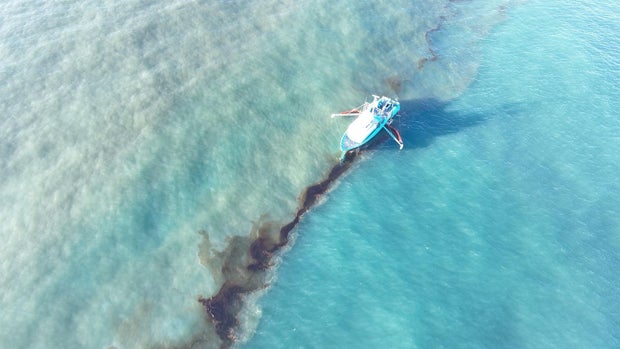
U.S. COAST GUARD PHOTO, COURTESY CLEAN GULF ASSOCIATES
“The volume of discharged oil is currently unknown,” officials said Tuesday. “…Initial engineering calculations indicate potential volume of crude oil that could have been released from the affected pipeline is 1.1 million gallons.”
Photos of the spill show large chunky globules and long slicks of oil floating on the Gulf’s surface.
Plaquemines Parish officials wrote on Facebook over the weekend that they are “monitoring the incident,” but have not posted any further updates….
Matt Rota, senior policy director for Healthy Gulf, told CBS affiliate WWL-TV that the amount of oil thought to have spilled could still increase.
“Especially when estimates come from companies…their business interest is to show that the smaller amount is coming out because they are liable for fines,” Rota said.
NOAA is helping oversee the incident, and the agency’s emergency operations coordinator Doug Helton told WWL that it’s not necessarily the amount of oil, but its impact, that is of most concern.
“There are endangered and threatened species in Louisiana waters. Most of the coastal Louisiana is wetlands and marshes, and that’s typically considered really sensitive to oil,” he said. “…Even if this doesn’t make it ashore, it doesn’t mean that this is an incident that we can just ignore. There are a lot of things that live out in the gulf.”
Turtles are “probably one of the biggest concerns that we might have,” he said.

Unified Command responds to
oil discharge near Main Pass,
LA / Courtesy of U.S. Coast Guard
Just north of the spill and Plaquemines Parish lies the Chandeleur Islands, where last year, the world’s most endangered sea turtle species, the Kemp’s Ridley, was found hatching for the first time in three-quarters of a century. This species is the world’s smallest sea turtle species that has been considered endangered in the U.S. since 1970. Globally, they’re considered critically endangered by the International Union for Conservation of Nature and Natural Resources, meaning they are at “extremely high risk of extinction in the wild.”
The Gulf is also home to what’s considered some of the most endangered whales in the world.
NOAA revealed last year that Rice’s whales, which can grow to be longer than a full-size school bus, are the only baleen whales known to inhabit Gulf waters. They’re primarily located between Louisiana and Florida, and NOAA believes that there are fewer than 100 of the whales remaining. Pipelines are a major risk to their existence, scientists have warned.
“Continued oil and gas development in the Gulf represents a clear, existential threat to the whale’s survival and recovery,” a group of 100 scientists said in a letter to the Biden administration last year. “The government’s Natural Resource Damage Assessment on the Deepwater Horizon oil spill estimates that nearly 20% of Gulf of Mexico whales were killed, with additional animals suffering reproductive failure and disease.”


