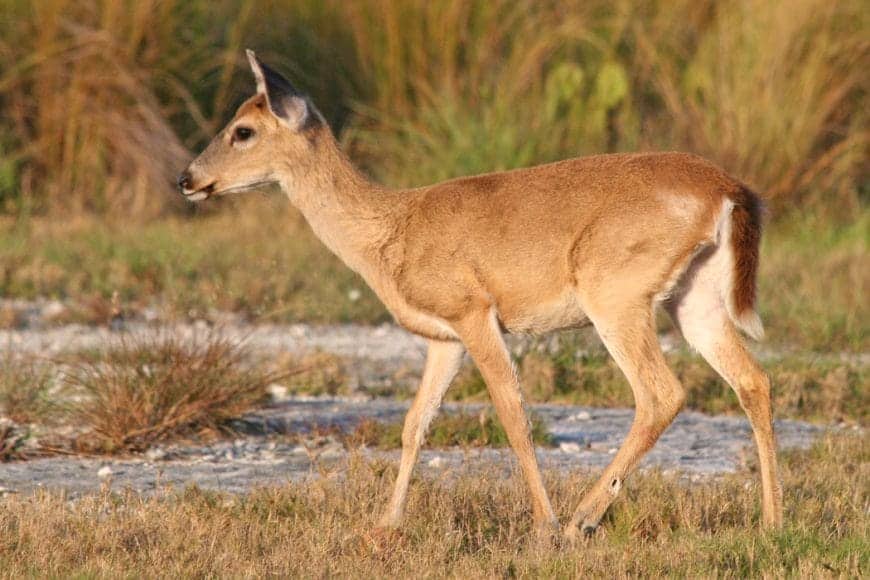
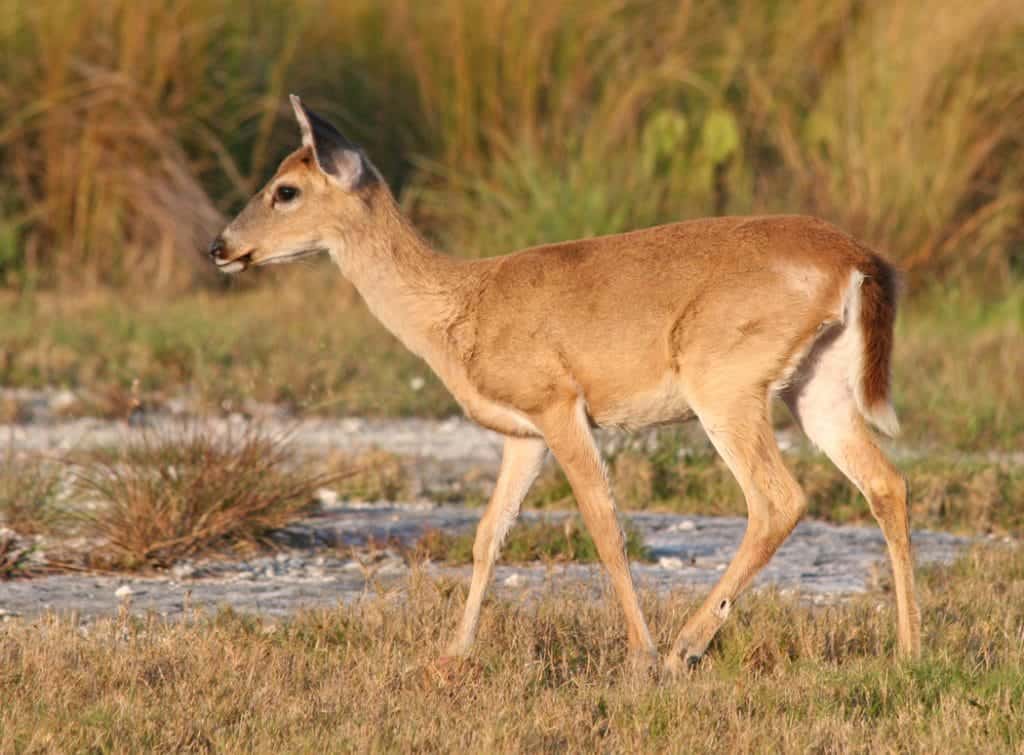
Key deer, unique to Florida, face extinction from climate-change caused rising seas. Already rising seas have claimed the Key Largo Cactus.
Read the original article with many photos here at Associated Press.
Comments by OSFR historian Jim Tatum.
jim.tatum@oursantaferiver.org
– A river is like a life: once taken,
it cannot be brought back © Jim Tatum
Florida’s iconic Key deer face an uncertain future as seas rise
After going nearly extinct in the middle of the 20th century due to hunting, experts say the diminutive Florida Key deer now face an even more existential threat: sea level rise. AP video by Daniel Kozin.
BIG PINE KEY, Fla. (AP) — The world’s only Key deer, the smallest subspecies of the white-tailed deer, are found in piney and marshy wetlands bordered by the Atlantic Ocean and Gulf of Mexico on the Florida Keys. For years, their biggest threat was being struck by vehicles speeding along U.S. Highway 1 or local roads.
But those waters surrounding the islands now pose the biggest long-term risk for this herd of about 800 deer as sea rise jeopardizes their sole habitat.
These charismatic diminutive deer have been listed as endangered for almost 60 years after their numbers dipped to about 50 from hunting and poaching long ago. Yet they’ve made a tremendous comeback, with a peak population of about 1,000 in the mid-2010s before a deadly parasite and Hurricane Irma took a heavy toll.
However, experts and wildlife advocates say this conservation success story today is at risk of being undone by climate change. Sea level rise is already altering the landscape of Big Pine Key and at least 20 smaller islands the deer call home.
The bulk of the deer live on Big Pine Key, a marshy island 30 miles (48 kilometers) from Key West. They roam neighborhoods where about 4,500 people live, browsing on lush gardens and drinking water from buckets residents put out for them as natural freshwater supplies dwindle.
“They were always vulnerable,” said Chris Bergh, the South Florida program manager for the Nature Conservancy, who oversees sea level rise projects and lives in Big Pine Key. “They’re much more vulnerable now. And with the sea level rising and their habitat shrinking, they’re becoming even more so.”
On Big Pine Key, mom and pop bars and restaurants dot either side of bustling U.S. 1, along with gas stations and small motels. The main industry revolves around the water — charter boats, fishing, diving, vacation rentals.
To protect the deer from being hit by vehicles, signs tell motorists they’re entering deer habitat. A 2-mile (3.2-kilometer) stretch of U.S. 1 is elevated and fenced, allowing deer to cross under the road. And speed limits are strictly enforced, often frustrating tourists driving to Key West.
Deer still are struck at an alarming rate. “The bottom line is that some 90 to 120 deer are known to be killed by vehicles each year,” said Jan Svejkovsky, chief scientist for Save Our Key Deer.
Wildlife officials have worked hard get out the message: Don’t feed Key deer. They fear deer will approach cars and go near roadways for handouts.
Even with the traffic deaths, the population has remained stable. But a larger threat looms.
The National Oceanic and Atmospheric Administration projects that by 2100, seas will rise 1.5 feet to 7 feet (0.5 to 2 meters) in parts of the Florida Keys. The threat is greatest to low lying islands like Big Pine Key, where the highest point is only about 8 feet (2.4 meters) above sea level.
Sea rise will continue to shrink freshwater and food sources Key deer need to survive, experts say.
“So as the sea rises, that shrinks the amount of available freshwater, the amount of available, palatable vegetation, the places for bearing their young,” said Bergh of the Nature Conservancy. “It puts them increasingly in conflict with people who are also occupying those higher grounds.”
In addition to sea rise, climate change brings the threat of stronger hurricanes, with storm surges that can damage deer habitat and freshwater supplies.
Salt water intrusion also is responsible for killing many of the Florida slash pines that gave Big Pine Key its name. Mangroves are growing in their place in an ever-changing environment, choking deer habitat even more.
Shrinking habitat drives deer to neighborhoods
Key deer on Big Pine Key move through neighborhoods, munching on gardens. Some people even have names for ones that frequent their yards.
“They are very gentle, very, very gentle,” said Connie Ritchie, who sometimes sees about 30 deer a day. “And the longer you live here, the more you want to protect them. Big time. Protect them because they’re so innocent.”
“They have certain plants that they really love,” Ritchie said, noting that the federal deer refuge here hosts events where it gives away native plants. “So they’re trying to teach us to plant the plants that the deer won’t eat.”
Development on Big Pine Key began in the 1970s and 1980s “when entire swaths of land on islands that still held deer were developed into planned subdivisions, complete with saltwater canal networks to provide lot-buyers with direct water access,” said Svejkovsky of Save Our Key Deer.
While the key remains mostly rural with modest Florida bungalows and more palatial places, development has taken away some deer habitat.
The deer have adapted to the humans and move freely between wild spaces and the neighborhoods. “They roam, they spend their day grazing,” Hosokawa said. “We don’t have a really nutritionally dense soil, so they need to eat a lot of food to get what they need. But trust me, they’re very goo at it. If it’s soft and tender, they will try to eat it.”
Future of the deer
The future, while uncertain, looks grim.
Just six inches (15 centimeters) of sea rise, expected by 2030, would mean loss of 16% of the freshwater holes on Big Pine Key, said Nova Silvy, professor emeritus with Texas A&M University who has studied Key deer since 1968 and has lived here for several years.
By 2050, sea rise is expected to overtake about 84% of the 1,988 remaining acres (805 hectares) of the preferred habitat on Big Pine Key — and “the deer will already be gone,” Silvy said.
What happens if the deer can’t survive in the Keys?
Bergh said he prefers to buy more time to keep the deer viable here. “And at some point, if that’s no longer possible, I personally think zoos are the most responsible alternative,” he said. “But that’s a terrible alternative. Who wants that for a wild animal?”
In rare instances, scientists have been allowed to relocate endangered species threatened by climate change as a last resort. But Silvy said, “The problem is if you take them any other place with deer, they’re going to interbreed and then you’ve lost the Key deer.”
Frisaro reported from Fort Lauderdale, Fla.
The Associated Press’ climate and environmental coverage receives financial support from multiple private foundations. AP is solely responsible for all content. Find AP’s standards for working with philanthropies, a list of supporters and funded coverage areas at AP.org.