
The following was written and published by Lucinda Faulkner Merritt in 2017. As foretold in this article, Rum Island spring has spent much of this past year in reversal; the pressure from the artesian blue water was no match for the tannic river. Read until the end for how you can help.

OSFR President Joanne Tremblay
joanne.tremblay@oursantaferiver.org
“Giving Our River A Voice”
Published by Lucinda Faulkner Merritt in the Gainesville Sun, 2017.
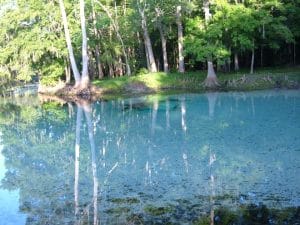
In 2005, I moved near the Santa Fe River in part because I’d be close to a beautiful little blue spring at Rum Island.
My visits to Rum have been fun, inspiring and soul healing. I’ve seen the spring in bitter winter, when mists whirled on the water like dancing spirits. I’ve been followed by a school of tiny fish as I waded in golden water while the rising river encroached into the spring.
I’ve gone swimming on a warm Christmas day, taken photos on a magic May morning when the last evening’s rain dripped from the trees, and hiked to other small springs upriver. And I’ve seen the spring completely covered by dark river water, re-emerging only when the river receded.
And all that time, Rum Island Spring was slowly dying.
I knew that the Santa Fe River springs, like many of Florida’s springs, were in trouble because of pollution and falling groundwater levels. But it was a chance comment on a Facebook post that was my wake-up call.
Lars Andersen, river guide and owner of Adventure Outpost in High Springs, gave that call: “Sadly, it looks like Rum Spring will be the next to go. It’s in the death throes … Santa Fe’s springs seem to be on the front line of the slow demise of all Florida’s springs … .”
Andersen wrote of the “browning” of the previously blue water at Rum Island during a relatively minor high water event. There have been occasional brownings in recent few years, he wrote, but they were rare and happened with higher water.
Anderson wrote they were “now happening more frequently and with less river water to make it happen. This was the same pattern we’ve seen in Poe and Lily before they lost their color. While those springs aren’t completely brown, they now have a very apparent mix of brown river water and spring water even in the best conditions.”
Further upstream, he wrote, the story is the same for Columbia and Hornsby springs. It looks like Rum is following that pattern, according to Anderson.
“It may get clear again — maybe even several times — but if the pattern holds, the color will slowly morph into the brownish/greenish mix of river water and spring water we’ve seen in the others,” he wrote.
As he wrote, all of Florida’s 1,000-plus springs are losing their flow, some faster than others. The combined average of all the 300-plus springs on and near the Suwannee basin have declined an average of 48 percent, according to Anderson.
In response to a question, Bob Knight of the Florida Springs Institute wrote: ”Lars and I have both been observing these declines for decades. Just as Poe stopped flowing during the 2012 drought, that tragedy will be coming soon to Rum.”
These predictions from trained observers sent me looking for scientific data that would confirm their theories. I found it. Scientists have documented flows at Rum Island Spring of 60.8 cubic feet per second (cfs) in 1990, 23.7 cfs in 2000, but only 15.8 cfs in 2010.
Given the current pattern on the Santa Fe River, I wonder: If Rum Island Spring dies, will Gilchrist Blue Spring be next? Ginnie? Ichetucknee? Are we willing to let this happen?
I’ve heard that every drop of water we use is one less drop for our springs. If we don’t want our springs to die, agriculturalists as well as homeowners must use less water — but implementing agricultural change is going to take time. The best thing many of us could do right now is to lose our lawns, since lawn irrigation is usually the largest use of water by homeowners.
What would a “Lose Your Lawn/Save Our Springs” water ethic look like? What if …
— Everyone with lawns in the Santa Fe River springsheds (ex: Alachua, Columbia, and Gilchrist counties) quit watering, fertilizing and using pesticides? Or installed rain barrels or gray water systems as alternatives to using groundwater?
— We switched all or part of our yards from turf grass to native plants, ground covers or wildflower meadows?
— We made water conservation a top priority?
— We worked to convince local governments, businesses and homeowner associations to model this effort and to find ways to help people make needed changes?
Could we do it? Will we do it? The alternative — a dry sinkhole where Rum Island Spring once flowed — is too tragic to contemplate. Yes, change is hard. But our springs are treasures worth saving.
Lucinda Faulkner Merritt lives in Fort White.





The solution seems simple, stop the bottling companies from stealing and exporting our natural resources. Unfortunately it is not as easy as it sounds. Our sacred waters are being sold for profit.
Sara, the solution is simple as posited by Florida Springs Institute: across the board reduction of every consumptive use permit. This should include mining, agriculture, landscaping, water bottling, municipalities. We ALL need to be part of the solution. Wasting our most precious resource to dilute our most pernicious pollutants should be a crime. Why are phosphate mines allowed to mismanage toxic stacks that break through and spill into our aquifer? Why do we raise beef and dairy in our highest recharge zones where nitrates from fertilizer and cow manure leach directly into our drinking water? Why do we continue to normalize turf lawns which require HUGE amounts of watering and fertilizing in our sandy soils? To save our springs and aquifer we ALL need to make changes to be part of the solution.