
To answer Mr. Lilker’s question in the title of his article, No, there will NOT be enough water in this plan for the future. There is not enough right now at this moment.
This plan is just a taxpayer waste of money. It serves for the water district to appear to be earning its way in life, which it does not.
Someone asked me for comments regarding this plan, and I wrote the following:
It must be pointed out that the current status of the Santa Fe River is drastically different today from historic times when the flow was approximately 30 per cent higher. The State of Florida should assess its goal for restoration based on the river’s normal healthy condition and not the weakened version of today. The license for withdrawals and reduced flows is called the Minimum Flows and Levels policy which allows the river to be continually drawn down.
Current withdrawals are not sustainable and, just as the “Water supply planning is an ongoing process with enhanced scientific methodologies and new data are acquired all the time,” groundwater pumping is also increasing all the time. Our Santa Fe River agrees with Florida Springs Institute that pumping permits must be reduced by 30 per cent across the board and all new permits must be suspended if the water management districts’ unrealistic goals are to be approached.
The proposed projections are unlikely to be met as we see that the current BMAPs are ineffective and our MFLs keep going closer to the bottom of the river. The MFLs for the Florida Outstanding Springs look very unhealthy for 2045. Failure to meet projections results in no negative consequences for the water planners.
The unhappy situation is that there is not enough water, ground, surface, waste or whatever, to satisfy current needs if we are to restore our springs and rivers to historic levels, let alone serve increased population and usage. The current usage is unsustainable as our rivers and aquifer drop. We must curtail pumping and stop destroying our wetlands.
These hard facts leave the water districts in a difficult position. Water users will demand unrealistic amounts of water, but an honest look at the situation shows us that current usage is not sustainable, as we have been losing the battle for decades. If we don’t want to finish killing our rivers and springs, there is no alternative but to pump less.
Western states have gone a step beyond our situation in Florida, and we need only look there to see what awaits us here if we don’t change.
—————–
The following is a cryptic statement referring to this 20-year plan from a local water expert who is very familiar with North Florida’s water crisis. I think it is a pretty good summation of all the taxpayer-funded hours that the water managers used to make their useless report:
That entire document is nothing but a Re-use and Recharge Plan. It’s completely off the target: clean, healthy, abundant water for the people and natural systems. We need at least 30% reduction, not a 33% increase in freshwater use in the next 20 years.
Read Stew Lilker’s original article at the Columbia County Observer.
Comments by OSFR historian Jim Tatum.
jim.tatum@oursantaferiver.org
– A river is like a life: once taken,
it cannot be brought back © Jim Tatum
North Florida Regional Water Supply Plan: Just a Suggestion – Will There Be Enough Water in the Future?October 9, 2023 10:45 pm | 4 min read
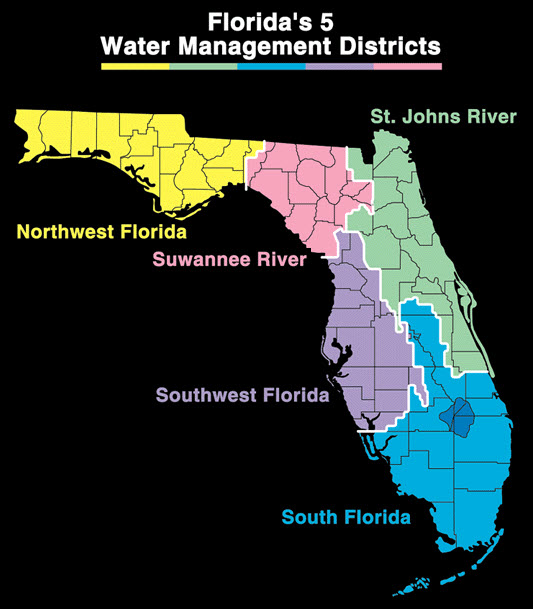
COLUMBIA COUNTY, FL – The North Florida Regional Water Supply Plan (the east side of the Suwannee River Water Management District and the top half of the St. Johns River Water Management District) is being updated. The Plan focuses on the sustainability of resources. It is just a plan, and water users “are not required to implement” any options identified in the Plan. There are all sorts of explanations for the North Florida Regional Water Supply Plan (NFRWSP). One claims the plan is 2020–2045. Government speak confuses the issue. The North Florida Regional Water Supply Partnership web page explains the 2023 Water Supply Plan this way: “Since 2021, the Districts have been working with stakeholders to update to the 2015–2035 North Florida Regional Water Supply Plan (NFRWSP), which was approved at a joint meeting of the St. Johns River Water Management District (SJRWMD) and Suwannee River Water Management District (SRWMD) governing boards in January 2017. This work is being conducted to meet the requirements of Section 373.709 of the Florida Statutes, which requires the Districts to reevaluate their determinations concerning the need for a water supply plan at least every five years. The development of the 2023 NFRWSP (2020–2045) is being conducted in an open process with local governments and other stakeholders.” While the data and explanations might be confusing, The purpose of the Plan is to evaluate how much water will be needed in 2045 and whether the traditional sources of groundwater (the water below the ground) can meet the future demand. The Plan is supposed to analyze if springs and wetlands in the Plan’s footprint will be protected as the aquifer and other natural water sources are pumped out. If South Florida is an example, we’re all in trouble. Developers take no prisoners. Suwannee River Water Management District (SRWMD) is conflicted about whether it is a water-permitting or public resource management agency. The St. Johns River Water Management District (SJRWMD) is widely believed not to be concerned about conservation while pumping as much water as is requested.
Fun FactsThe SRWMD is 7,640 square miles. Its footprint includes all or part of 15 counties in North Central Florida, 13 River basins, and, as of 2020, a population estimated to be 360,000. The SRWMD is the smallest of the State’s water management districts in area, population, tax base, and agency personnel. The St. Johns River water management district is 12,283 square miles, covers 18 counties, and, as of 2020, 5.6 million people. There are 148 known springs and 1,400 lakes in the district. Amy Brown, Ph.D. – 2023 Plan Update
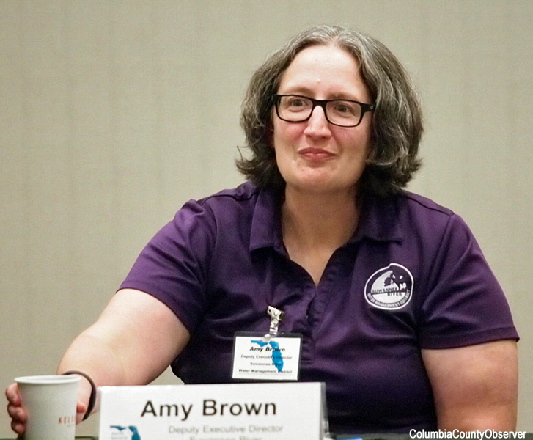
Amy Brown, Ph.D., is the Water Resources Deputy Executive Director for the SRWMD. She is responsible for implementing and coordinating district programs and projects related to water resource monitoring, minimum flows and levels, groundwater modeling, environmental and water resource projects, and water supply planning. Ms. Brown began working at the district in 2016 and holds a Bachelor in chemistry from Michigan State University. She has a Masters degree in geology from Sue Ross State University and a Ph.D. in geological sciences from UF. On September 28, 2023, Ms. Brown presented an in-person update to the North Florida Regional Water Supply Plan to the NCFRPC. Florida statute (section 373.709) states: “The governing board of each water management district shall conduct water supply planning for a water supply planning region within the district identified in the appropriate district water supply plan under s. 373.036, where it determines that existing sources of water are not adequate to supply water for all existing and future reasonable-beneficial uses and to sustain the water resources and related natural systems for the planning period.” The water use in the planning area is anticipated to almost double along with a doubling in the population (slide 6). The WMD figures seem low, as it uses figures from 2015. Fort White and Lower Santa Fe – Ichetucknee area are front and center in slide 9. This is a significant area as Columbia County’s County Chair is building a subdivision smack in the Ichetucknee Recovery Strategy Area. Saltwater infusion, the ocean’s water permeating into the groundwater, is a problem in South Florida. In slide 12, chloride concentrations mean saltwater intrusion. For folks who don’t know, the slide should have said that. Will the Water Management Districts be able to meet future water supply demands? The North Florida Regional Water Supply Plan seems to say yes on slide 17. Is this realistic in light of the SJRWMD policies and the SRWMD’s continuing failures to adequately manage the region’s water? Whatever goes on in the region will cost money. Ms. Brown lays out the funding options at slide 22. The WMD projects a 135 mgd increase in groundwater demand from 2015 to 2045 (slide 23) and concludes the obvious, “Future demand cannot be met with traditional sources without potential impacts to water resources.” The WMD claims it has identified 158 mgd of projected options “that meet future demand while sustaining water resources and related natural systems.” If you want to gain greater insight into the region’s water management planning, the rest of Ms. Brown’s slide pack will give you some insight into the process and links to explore the plans further. EpilogueThe SRWMD states, “Traditional sources cannot meet future demand while protecting water resources.” The WMD claims, “Future demand can be met while protecting water resources through a combination of alternative sources and other identified projects.” If you enjoy clean water, springs, rivers and lakes, and the quality of life that many areas in North Florida provide, the North Florida Regional Water Supply Plan is something to pay attention to. |