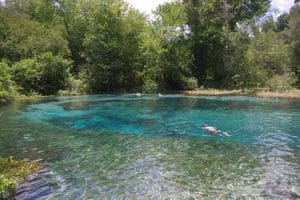
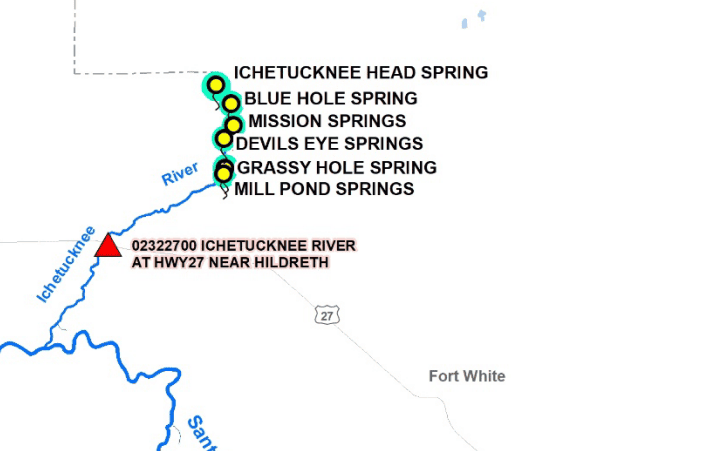
Of the nine named springs along the upper 2.5 mile section of the Ichetucknee River, six are Outstanding Florida Springs (OFS): Ichetucknee Head (OFS), Cedar Head , Blue Hole (OFS) , Mission Spring Group (OFS) , Roaring and Singing , Devils Eye (OFS), Grassy Hole (OFS), Mill Pond (OFS) and Coffee.
Outstanding Florida Springs are historic first magnitude springs that are legally protected by Senate Bill 552 “Florida Springs and Aquifer Protection Act,” requiring that minimum levels (MFLs) be set. The MFL’s are NOT being met and the Suwannee River Water Management District (SRWMD), is claiming that an unfunded wetland project with a 20 year completion date will restore our spring flow rather than restricting water use permits.
The top 124 properties with estimated groundwater uses greater than 100,000 gallons per day (gpd) extract about 90 percent of this estimated groundwater use. The largest users affecting the supply of groundwater to Ichetucknee Springs are Lake City, as well as several hundred large agricultural irrigation wells.
Reported flows at the US 27 gauge station upstream of the Ichetucknee Springs System input averaged 1,604 cfs between 1927 and 1960. The Ichetucknee Spring System flow restoration goal is to increase average spring discharge to 95 percent of historic levels or about 346 cfs. This will require reduction of pumping in and surrounding the existing springshed by about 23 MGD.
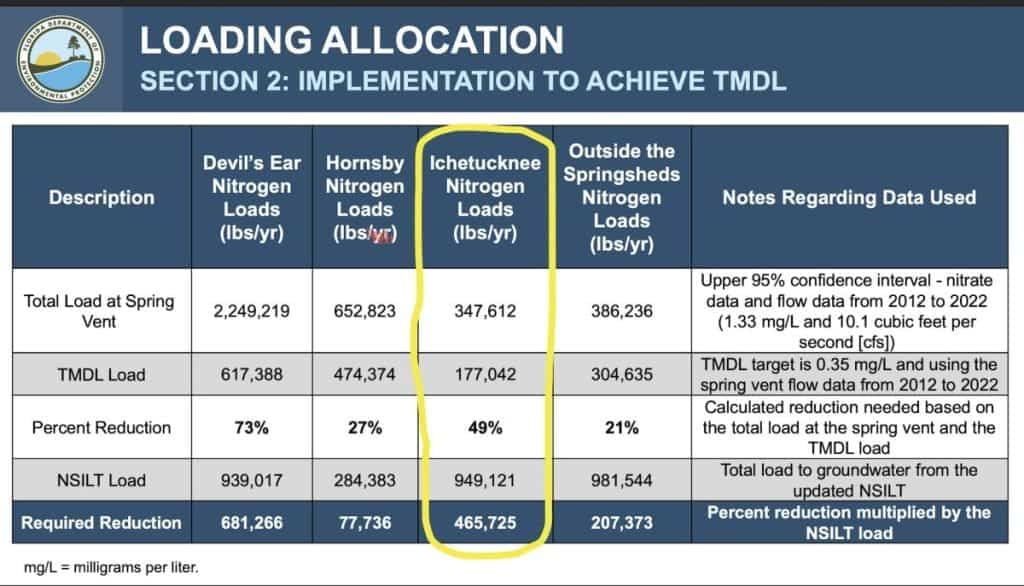
These Outstanding Florida Springs also have seen nitrogen concentrations increase from less than 0.23 mg/L in 1946 to an average of 0.80 mg/L over the past two decades. Row crops, cattle production, golf course, and highly landscaped properties are the leading sources.
Reduced flow and high nutrient levels are turning these springs green with algae. Let us do what we can to reduce the impact to our Outstanding Springs.
You can help protect our river and springs by:
Reducing water usage in home and on your landscape
Maintain your Septic tank.
For a deeper dive, read:
BMAPS: Draft Santa Fe River Basin Management Action Plan, April 2025, https://floridadep.gov/sites/default/files/250410_SAFE_BMAPUpdateMeetingMaterials.pdf
Blueprint For Restoring Springs On The Santa Fe River, Florida Springs Institute, 2021, https://floridaspringsinstitute.org/wp-content/uploads/2021/01/Santa-Fe-River-and-Springs-Restoration-Blueprint-01_27_21.pdf, accessed online 5/25/25
Development of Karst Traces in the Santa Fe Basin, 2019, Southeastern Geological Society, February 23, 2019, https://segs.org/wp-content/uploads/2019/02/SEGS-Guidebook-76.pdf
Economic Contributions and Ecosystem Services of Springs in the Lower Suwannee and Santa Fe River Basins of North-Central Florida, Borisova, T., Hodges, A, and Stevens, T., 2014, UF, https://alachuacounty.us/Depts/epd/WaterResources/WaterData/Report%20Documents/Final%20Report_Springs_Economic_Report_6-4-14.pdf
First Magnitude Springs of Florida, Thomas M. Scott, Guy H. Means,Ryan C. Means, and Rebecca P. Meegan, Florida Geological Survey, 2002, https://lake.wateratlas.usf.edu/upload/documents/FirstMagnitudeSprings-OpenFileReport85-FGS.pdf
Minimum Flows And Minimum Water Levels Re-Evaluation For The Lower Santa Fe And Ichetucknee Rivers And Priority Springs Final, HSW Engineering, 2021, https://www.srwmd.org/DocumentCenter/View/17834/LSFIR-MFL-Report-Final
Springs Fever: A Field and Recreation Guide to Florida Springs, Follman, J., and Buchanan, R. (n.d.). 2025 from http://thespringsfever.com/xxSantaFeChapter.html
~~~~~~~~~~~~~~~~~~~~~~~~~~~~~~~~~~~~
Comments by OSFR Board Member J.T.
Media@oursantaferiver.org
“Giving the River a Voice”