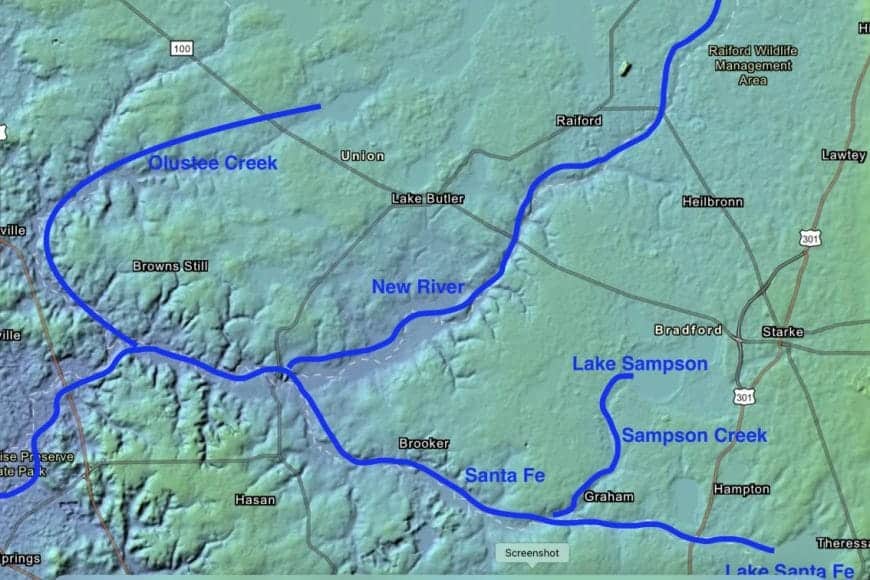
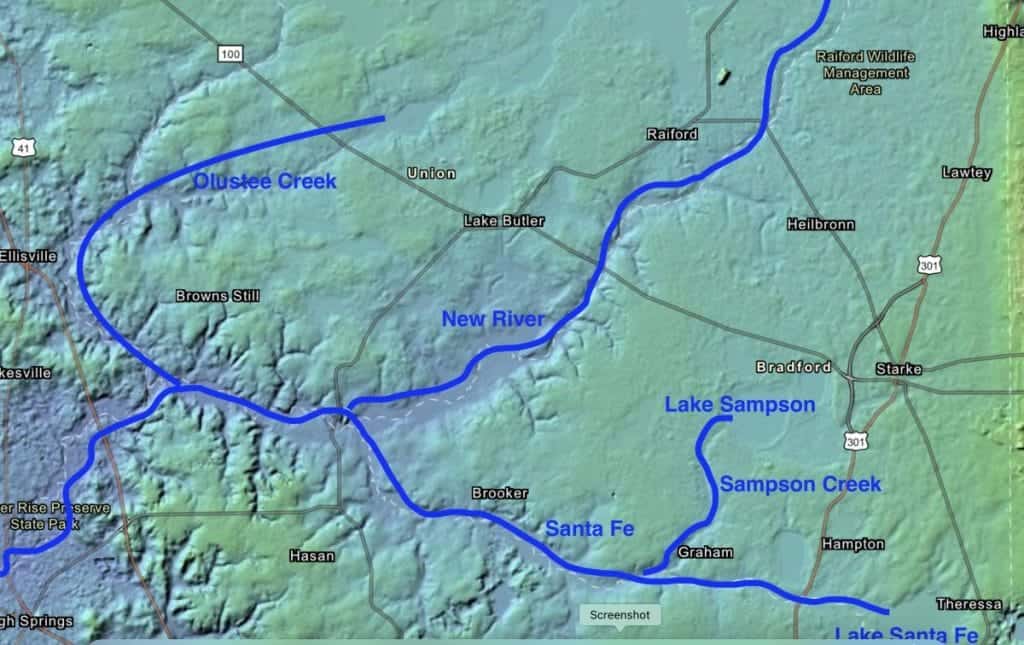
Lake Santa Fe, Little Lake Santa Fe, Lake Alto, Lake Sampson, Sampson Creek, New River, Olustee Creek, Ichetucknee plus all the various springs flow into the Santa Fe which flows into the Suwannee. To know our river, we explore all parts. This week I traveled to Lake Sampson to meet and talk to residents about changes to their once bountiful lake.
I also took advantage of the high water around Worthington Springs 54’88” to poke into the New River, a significant contributor to the Santa Fe. The flow was so strong I could barely make progress paddling up against the current. Chastain-Seay Park outside of Worthington is lovely. The red river is lively after the New River’s contributions. Paddling left takes one to the confluence. The mouth of which is somewhat tangly with small trees but soon clears to an open passageway.
To paddle downstream, one flows past the park which once held a hotel and spa complex. In the mid-twentieth century, the the spring flow reduced and then stopped flowing completely. Passage down river towards O’Leno is blocked by thickets of trees and not recommended.

OSFR President Joanne Tremblay
joanne.tremblay@oursantaferiver.org
“Giving Our River A Voice”




Regarding Worthington Springs: “The demise of the name-sake spring in the town of Worthington Springs, Florida is similar to the demise of Kissengen Springs from phosphate mining in the Peace River Basin (Lewelling et al., 1998) and the demise of the name-sake spring in the town of White Springs, Florida from phosphate mining of tributary wetlands to the Suwannee River.” Bernardes, S.,Manglass, L., Bacchus, S. T., & Madden, M.(2019). Analysis and Extent of Santa Fe River Flooding in North Florida Attributed to Rainfall and Wind Damage Associated with Hurricane Irma. Journal of Geoscience and Environment Protection, 7,
253-310. https://doi.org/10.4236/gep.2019.711019