
Santa Fe River Origins: the Upper Santa Fe
Paddle Trail Maps
Access Points on the Suwannee River Basin, including the Santa Fe River
Resources
Springsheds are complex, cavern dominated, and partially interrelated systems that “should be treated as one until additional research can better delineate their boundaries (Upchurch et al. 2011).” The surrounding lands have high recharge capacity meaning everything above ground: fertilizer, herbicide, septic waste, and rain, trickles into our aquifer.
1. Hornsby Springshed (River Rise, Hornsby, Treehouse, Columbia)

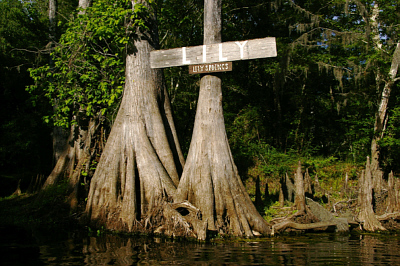
2. The Poe Springshed: Alligator, Poe, Lily, Pickard

3. Gilchrist Blue Springshed (Jonathan, Rum, Gilchrist Blue)

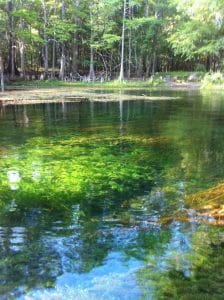
5. Sunbeam-Wilson Springshed

6. Ichetucknee Springshed

7. Three Rivers to the Suwannee

1. The Hornsby Springshed
Group 1: Hornsby Springshed (Hornsby Springs Priority Focus Area)
River Rise (Alachua) is a 1st magnitude spring in Alachua County in the Santa Fe Rise basin.
Treehouse Spring (Alachua) is a 1st magnitude spring in Alachua County in the Treehouse Spring basin.
Col428981 (Columbia) is a 3rd magnitude spring in Columbia County in the Santa Fe River basin.
Darby Spring (Alachua) is a 2nd magnitude spring in Alachua County in the Santa Fe River basin.
Hornsby Spring (Alachua) is a 2nd magnitude spring in Alachua County in the Hornsby Spring basin
Columbia Spring (Columbia) is a 1st magnitude spring in Columbia County in the Columbia Springs basin.


2. The Poe Springs Springshed: Alligator, Poe, Lily, and Pickard
After Columbia Springs in the Hornsby Springshed, the Santa Fe River meanders back and forth forming the top half of a heart ending at the Columbia County Boat Ramp on CR 27. There the river straightens out to deliver a few springs beginning with a midriver boil also known as Alligator Spring. the following is a list of springs within the Poe Springshed.
- Alligator Spring (Alachua) is a 2nd magnitude mid-river spring in Alachua County in the Santa Fe River basin.
- Ala930971 (Alachua) is a 2nd magnitude spring in Alachua County in the Santa Fe River basin.
- Allen Spring (Columbia) is a 2nd magnitude spring in Columbia County in the Santa Fe River basin.
- Poe Spring (Alachua) is a 2nd magnitude spring in Alachua County in the Poe Spring basin.
- Poe Woods Spring (Alachua) is a 4th or higher magnitude spring in Alachua County in the Santa Fe River basin.
- Col930971 (Columbia) is a 2nd magnitude spring in Columbia County in the Santa Fe River basin.
- Lily Spring (Gilchrist) is a 2nd magnitude spring on private property in Gilchrist County in the Santa Fe River basin.
- Pickard Spring (Gilchrist) is a 2nd magnitude spring on private property in Gilchrist County in the Santa Fe River basin.
- Col101971 (Columbia) is a 3rd magnitude spring in Columbia County in the Santa Fe River basin.



3. Gilchrist Blue Springshed
Jonathan, Rum Island, Gilchrist Blue, and Naked Springs are within the Gilchrist Blue Springshed, a sub-basin of the Devils Eye Springshed. The following is a list of springs within the Gilchrist Blue Springshed:
- Jonathan Spring (Columbia) is a 3rd magnitude spring in Columbia County in the Santa Fe River basin.
- Col101974
- Col101975
- Rum Island Spring (Columbia) is a 2nd magnitude spring in Columbia County in the Blue Spring (Gilchrist County) basin.
- Gilchrist Blue Spring (Gilchrist) is a 2nd magnitude spring in Gilchrist County in the Blue Spring (Gilchrist County) basin.
- Naked Spring (Gilchrist) is a 4th or higher magnitude spring in Gilchrist County in the Blue Spring (Gilchrist County) basin.
- Little Blue Spring (Gilchrist) is a 4th or higher magnitude spring in Gilchrist County in the Blue Spring (Gilchrist County) basin.
4. Devils Ear Springshed (Devils Ear, Eye, July, Ginnie, Dogwood, Deer, Sawdust)
The Devils Ear Springshed consists of more than 200,000 acres of land that contribute water to the following group of springs:
Devils Ear is the only designated Outstanding Florida Spring (OFS) within this Springshed. This springshed is IMPAIRED due to high nitrates levels which are 73% higher than the state designated safe level. As a result, a Basin Management Action Plan (BMAP) has been enacted to reduce nitrate loading within this basin.
The Ginnie Springs Complex include Devils Eye, Ear, Little Devil, Ginnie, Dogwood, Twin, and Deer springs. These springs are all within privately run Ginnie Springs Outdoors, LLC . The Suwannee River Water Management District (SRWMD) has permitted up to 1 million gallons per day (mgd) to be withdrawn from wells within the Ginnie Springs complex. The water is pumped from wells near Ginnie by Seven Springs Water Co. which then sells he water to Blue Triton, formerly known as Nestle Waters North America.
Ginnie Springs Complex which include Devils Ear, Devils Eye, Little Devil, Ginnie, Dogwood, Twin, and Deer Springs.
Sawdust Spring (Columbia) a 3rd magnitude spring in Columbia County.


5. Sunbeam-Wilson Springshed
Between the Devils Ear and Ichetucknee Springsheds lie a couple of spring clusters spaced fairly well apart. The first cluster is dominated by the Siphon Creek Cave System. Siphon Creek Rise qualifies as a First Magnitude resurgent spring. Big Awesome, Little Awesome, and Myrtles Fissure are also part of this cave system.
Big Awesome swallets “is the most upstream of the Siphon Creek Cave System.” Accessible by boat, on the right side of the river heading downstream, after the shoals, marked by a large cypress, jog into a canopied space beside an island, and is dominated by a big circular pool. The hole is surrounded by a ledge. SRWMD once estimated that Big Awesome swallet takes in about 150 cfs.
The list of springs in this cluster and more going downstream include:
- Col1012971 (Columbia) is a 2nd magnitude spring in Columbia County in the Santa Fe River basin.
- Col1012972 (Columbia) is a 2nd magnitude spring in Columbia County in the Siphon Creek Rise (Gilchrist County) basin.
- Gil1012971 (Gilchrist) is a 2nd magnitude spring in Gilchrist County in the Siphon Creek Rise (Gilchrist County) basin.
- Gil1012972 (Gilchrist) is a 3rd magnitude spring in Gilchrist County in the Siphon Creek Rise (Gilchrist County) basin
- Siphon Creek Rise (Gilchrist) is a 1st magnitude spring in Gilchrist County in the Siphon Creek Rise (Gilchrist County) basin.
- Myrtles Fissure Spring (Gilchrist) is a 2nd magnitude spring in Gilchrist County in the Santa Fe River basin.
- Gil1012974 (Gilchrist) is a 2nd magnitude spring in Gilchrist County at the 47 bridge.
- Gil928972 (Gilchrist) is a 4th or higher magnitude spring inland from the river about 50 yards in an area of deep floodplain forest.
- Col928971 (Columbia) is a 3rd magnitude spring in Columbia County in the Santa Fe River basin.
- Wilson Spring (Columbia) is a 2nd magnitude spring in Columbia County in the Santa Fe River basin.
- Unnamed Spring (Gilchrist) is a 4th or higher magnitude spring in Gilchrist County in the Santa Fe River basin.
- Gil99974 (Gilchrist) is a 3rd magnitude spring in Gilchrist County in the Santa Fe River basin.
- Col917971 (Columbia) is a 3rd magnitude spring in Columbia County in the Santa Fe River basin.
- Jamison Springs (Columbia) is a 3rd magnitude spring in Columbia County in the Santa Fe River basin.
- Sunbeam Spring (Columbia) is a 2nd magnitude spring in Columbia County in the Santa Fe River basin.
- Oasis Spring (Gilchrist) is a 3rd magnitude spring in Gilchrist County in the Santa Fe River basin.

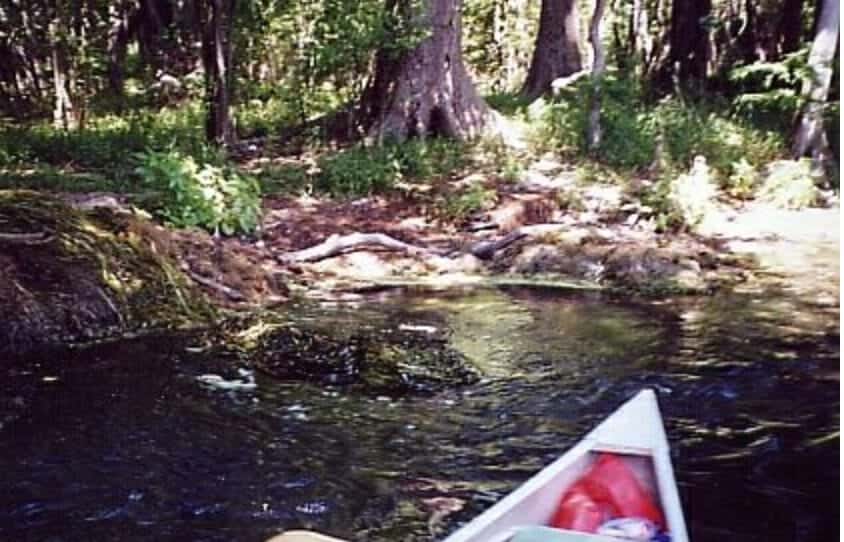


In 2021, Alachua Conservation Trust purchased a 195 acre tract of land on the Santa Fe River and called it Little Awesome Preserve. The name Little Awesome refers to a feature on the Santa Fe River that is only accesible by boat and not always visible. Recently it has been covered by a large tree trunk and hidden from view. Other times it is covered in vegetation. When the river is high enough to submerge this circular ‘portal,’ it emits the rushing sound of water swirling down a drain. When I first encountered Little Awesome, I feared it. The force of the water rushing down this circular chimney appeared like it could pull my canoe down. After a time I realized it was safe to canoe over it, even allowing myself to submerge into it and allowing the siphon to spin me around.
Little Awesome Suck, also on the right is higher on the bank and the only one that will become isolated from river inflow during periods of very low water levels and is often obscured by fallen vegetation. Surrounded by sharp karst rocks it forms a nearly circular hole that sometimes forms a whirlpool. “The SRWMD once estimated that Little Awesome Suck was taking in about 50 cfs.”
Myrtles Fissure churns out water with the energy of a waterfall or becomes a deep, narrow, stagnant slit of water on the upper banks of the Santa Fe. The fissure is not visible from the river and can the sharp slippery run can be accessed by boat, or through a hike along the riverside through the ACT’s Little Awesome Preserve. The fissure runs parallel to the river, is about 120′ from the river, is around 75′ long, 4′ wide. The shallow run of sharp karst is slippery. During high water, water gushes like a waterfall from the fissure and down the run to the river. One hears it before seeing it. When the river is low, water stagnates in the crack and the run is coated with algae.
6. Ichetucknee Springshed
Of the nine named springs along the upper 2.5 mile section of the Ichetucknee River, six are Outstanding Florida Springs (OFS): Ichetucknee Head (OFS), Cedar Head , Blue Hole (OFS) , Mission Spring Group (OFS) , Roaring and Singing , Devils Eye (OFS), Grassy Hole (OFS), Mill Pond (OFS) and Coffee.
Outstanding Florida Springs are historic first magnitude springs that are legally protected by Senate Bill 552 “Florida Springs and Aquifer Protection Act,” requiring that minimum levels (MFLs) be set. The MFL’s are NOT being met and the Suwannee River Water Management District (SRWMD), is claiming that an unfunded wetland project with a 20 year completion date will restore our spring flow rather than restricting water use permits.
The Ichetucknee ‘Trace’ refers to the path lakes, creeks, and surface waters take to the Ichetucknee Headspring. In a sense, all springsheds have these traces. The Ichetucknee Trace is well documented thanks to the dedication of geologists, divers, and other dedicated individuals. Jim Stevenson, retired chief biologist with the Florida Park Service presents this first recorded field trip with the help of a grant from the Columbia County Board of County commissioners. Produced by Lake City Community College, Stevenson takes a group of Columbia High School Students on a tour of the trace. This video manages to connect the trace of the water’s path to the Headspring of the Ichetucknee from Lake City.
In 2019, Gary Maddox, Rick Copeland, and Kate Muldoon published Development of Karst Traces in the Santa Fe Basin. This paper and field trip was a collaboration of many of our regions’ scientists and explorers. The publication is a wealth of geological, hydrological, and botanical exploration. Development of Karst Traces in the Santa Fe Basin, 2019, February 23, 2019, Southeastern Geological Society, https://segs.org/wp-content/uploads/2019/02/SEGS-Guidebook-76.pdf
7. Three Rivers to the Suwannee
The last leg of the Santa Fe begins at the confluence of the Ichetucknee and ends in the Suwannee River. The aerial image shows an increase in agricultural activities in this area.
Some of the springs below the Ichetucknee confluence are spring runs that pass through private property, many are mid-river boils. Though none are as pristine as the springs upriver, this stretch is busy with wildlife.

Florida Springs Institute ‘s Interactive Florida Springs Map allows the user to select a spring from the map to see an image of the spring with detailed information. The Interactive Map is a composite of decades of research by the Florida Geological Survey originally published in 1947and updated in 1977. “In recent decades, much has been learned about additional spring resources unreported in earlier compilations. In addition, a great deal of water chemistry information has been gathered to enable long-term trend analysis and interpretative dynamics of our subsurface aquifer flow regimes.” Springs of Florida.
The springs in the Three Rivers section include the following:
- At the confluence of the Ichetucknee and the Santa Fe, there is Suw917971 (Suwannee) is a 3rd magnitude spring in Suwannee County in the Ichetucknee River basin.
- Gil99972 (Gilchrist) is a 3rd magnitude spring in Gilchrist County in the Santa Fe River basin.
- Troop Spring (Gilchrist) is a 3rd magnitude spring in Gilchrist County in the Santa Fe River basin.
- Suw917972 (Suwannee) is a 4th or higher magnitude spring in Gilchrist County in the Santa Fe River basin.
- Campground Spring (Gilchrist) is a 3rd magnitude spring in Gilchrist County in the Trail Springs basin.
- Gil107972 (Gilchrist) is a 2nd magnitude spring in Gilchrist County in the Trail Springs basin.
- Trail Spring (Gilchrist) is a 3rd magnitude spring in Gilchrist County in the Trail Springs basin.
- Suw107971 (Suwannee) is a 2nd magnitude spring in Suwannee County in the Santa Fe River basin.
- Gil107971 (Gilchrist) is a 2nd magnitude spring in Gilchrist County in the Santa Fe River basin.
- Gil729971 (Gilchrist) is a 2nd magnitude spring in Gilchrist County in the Santa Fe River basin.
Resources
A Century of Low and Flow Reversals in the Springs of the Suwannee River, Dr. Matt Cohen, 2023, UF Howard T. Odum Center for Wetlands, online at https://www.youtube.com/watch?v=7ij0BTNAzSg.
An investigation of the Darby and Hornsby Springs, Alachua County, Florida (FGS: Special publication 7), 1961, Florida Geological Survey, https://ufdc.ufl.edu/UF00000471/00001/images/8
A Tour of the Ichetucknee River Trace, Jim Stevenson, et al., 2013, https://youtu.be/wryzOLGYM_Y?feature=shared
Aquifer Friendly Landscaping: curated list of online sources, https://osfr.org/nature-friendly-landscaping/
Blueprint For Restoring Springs On The Santa Fe River, Florida Springs Institute, 2021, https://floridaspringsinstitute.org/wp-content/uploads/2021/01/Santa-Fe-River-and-Springs-Restoration-Blueprint-01_27_21.pdf, accessed online 5/25/25
BMAPS: Draft Santa Fe River Basin Management Action Plan, April 2025, https://floridadep.gov/sites/default/files/250410_SAFE_BMAPUpdateMeetingMaterials.pdf
Development of Karst Traces in the Santa Fe Basin, 2019, Southeastern Geological Society, February 23, 2019, https://segs.org/wp-content/uploads/2019/02/SEGS-Guidebook-76.pdf
Drinking Water Nitrate and Human Health: An Updated Review, Ward et al., 2018, Int J Environ Res Public Health, https://pmc.ncbi.nlm.nih.gov/articles/PMC6068531/#abstract1
Economic Contributions and Ecosystem Services of Springs in the Lower Suwannee and Santa Fe River Basins of North-Central Florida, Borisova, T., Hodges, A, and Stevens, T., 2014, UF, https://alachuacounty.us/Depts/epd/WaterResources/WaterData/Report%20Documents/Final%20Report_Springs_Economic_Report_6-4-14.pdf
First Magnitude Springs of Florida, Thomas M. Scott, Guy H. Means,Ryan C. Means, and Rebecca P. Meegan, Florida Geological Survey, 2002, https://lake.wateratlas.usf.edu/upload/documents/FirstMagnitudeSprings-OpenFileReport85-FGS.pdf
Florida Paddle Notes, James Steele, 2018, https://www.floridapaddlenotes.com/, accessed online 5/25/25
Florida Springs Conservation Plan, Howard T. Odum Florida Springs Institute, https://floridaspringsinstitute.org/wp-content/uploads/2018/11/Springs-Conservation-Plan-final-draft-FINAL.pdf accessed online 7/15/25
Following the Ichetucknee, Jim Stevenson, Eric Flagg, 2014, Three Rivers Trust and Jellyfish Smack Productions, https://www.youtube.com/watch?v=1FHcKlMMI9A
Gilchrist Blue Spring Collapse Report, Florida Springs Institute, Fall 2023, https://floridaspringsinstitute.org/wp-content/uploads/2023/08/Gilchrist-Blue-Collapse-Report-1.pdf
Hornsby Spring, Howard T. Odum Florida Springs Institute, 2024, https://floridasprings.org/outstanding-florida-springs-hornsby-spring/
Hornsby Spring; A Florida Spring Odyssey, Alachua County, March 2017, Kirsten Work, https://floridaspringsodyssey.blog/2017/04/25/hornsby-spring-march-2017/
Hornsby Springs Restoration Project , Greg Owen, Alachua County Environmental Protection Department, 02/16/2023, https://tinyurl.com/2n9xx7r4
Interactive Florida Springs Map, Howard T Odum Florida Springs Institute, https://floridaspringsinstitute.org/springs-map-2-0/
Know Your Springshed, Spring Eternal Project, Copyright Springs Eternal Project, Alachua Conservation Trust, springseternalproject.org/springs/poe-springs/know-your-springshed-poe/
MFL: Lower Santa Fe and Ichetucknee Rivers MFL Status, Suwannee River Water Management District, SRWMD, 2022, accessed May, 2025, https://www.srwmd.org/DocumentCenter/View/17834/LSFIR-MFL-Report-Final
Poe Springs County Park EPD Restoration Effort, 2023.
Mill Creek and Lee Sinks Dye Trace, Alachua County, Fl, July-Dec 2005, Karst Environmental Services, Inc., 2006. https://shorturl.at/JhGAr
Old Timers Remember -Ichetucknee Springs, A History and Culture of a Florida Spring, P.C. Zick, 2025, https://pczick.com/ichetucknee-springs-book/
Onsite Sewage Program, FL-DEP, https://floridadep.gov/water/onsite-sewage
Peer Review Of The Proposed Minimum Flows And Levels For The Lower Santa Fe And Ichetucknee Rivers And Associated Priority Springs Final Panel Report , 2013, https://waterinstitute.ufl.edu/wp-content/uploads/UFWaterInstituteMFLPeerReviewFinalReport.pdf
Regional And Statewide Trends In Florida’s Spring And Well Groundwater Quality (1991-2003), STATE OF FLORIDA DEPARTMENT OF ENVIRONMENTAL PROTECTION, Rick Copeland, Neal A. Doran, et.al, 2011 , https://web.archive.org/web/20210526060040id_/http://publicfiles.dep.state.fl.us/FGS/FGS_Publications/B/B69rev_2011.pdf
Ruth B Kirby Gilchrist Blue Springs State Park, Florida State Parks, https://www.floridastateparks.org/…/history-ruth-b…,
Santa Fe River Field Trip, Alachua, Columbia, and Gilchrist Counties, Florida, 2014, Guidebook Number 61, The Southeastern Geological Society (SEGS), Peter Butt, Samantha Andrews,et.al. https://segs.org/wp-content/uploads/2010/01/Microsoft_Word__Sante_Fe_SEGS_Guidebook_No_61_FINAL.pdf, accessed online 5/25/25,
Springs Fever: A Field and Recreation Guide to Florida Springs, Follman, J., and Buchanan, R. (n.d.). 2025 from http://thespringsfever.com/xxSantaFeChapter.html
Springs of Florida (FGS : Bulletin 66), USGS, 2004, https://ufdc.ufl.edu/UF00094032/00001/thumbs
Springs 101, Howard T Odum Florida Springs Institute, 2024, https://floridasprings.org/springs-101/
Springsheds of the Santa Fe River Basin, by SB Upchurch · 2008 https://www.alachuacounty.us/Depts/EPD/Documents/WaterResources/Springsheds%20presentation.pdf,
When Springs Reverse, OSFR, 2024, https://osfr.org/when-springs-reverse/, accessed online 5/25/25
Water Conservation and Best Management Practices, SRWMD, https://www.mysuwanneeriver.com/294/Water-Conservation
JT/2025
Get in on the Conversation